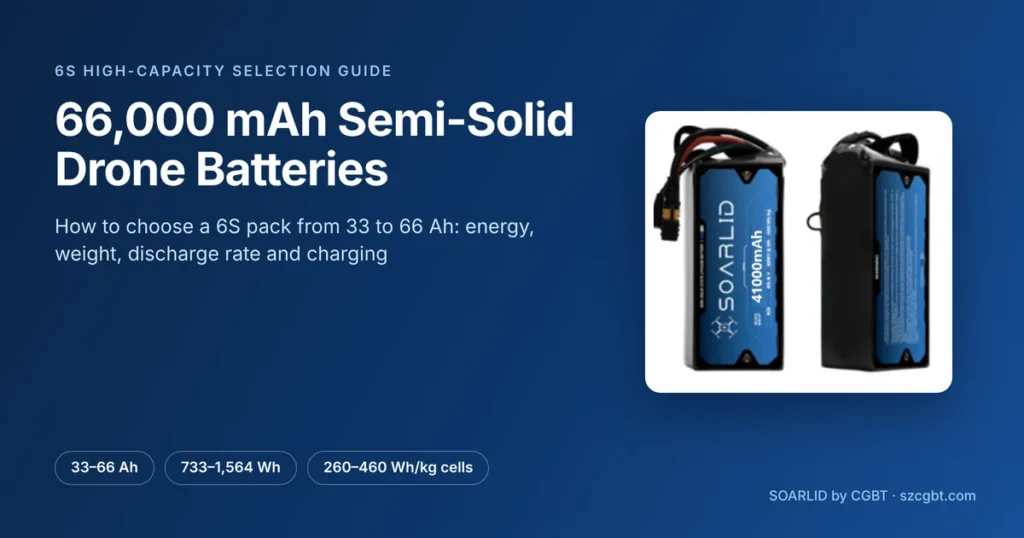
“66,000 mAh” has become shorthand for a big 6S semi-solid drone battery. It is the number buyers type into a search box, usually as 66000mAh, and the number printed largest on the label. It is also one of the least useful numbers for predicting how long your aircraft will fly. Two 6S packs with the same amp-hour rating can differ by up to 13% in stored energy, depending on cell voltage, and by more than a kilogram in weight. The heavier one may well give you the shorter flight.
This guide shows how to choose a 6S high-capacity semi-solid-state pack between 33 Ah and 66 Ah the way a propulsion engineer would: convert the label to watt-hours, weigh the pack, check the discharge rating against your real current, decide between one pack and two, and only then look at charging and cycle life. All product figures come from our published datasheets, and the flight-time example is built on a motor manufacturer’s published bench data so you can repeat it for your own airframe.
Key takeaways
- 66,000 mAh is 66 Ah. At 6S that is anywhere from 1,386 Wh to 1,564 Wh, depending on the cell’s nominal voltage. Compare packs in watt-hours, never in mAh alone.
- Flight time follows usable watt-hours divided by power, and power rises with take-off weight. Pack-level Wh/kg matters as much as capacity.
- In our worked example, 60% more battery energy bought only 25% more hover time, and a single 66 Ah pack hovered for less time than a lighter 60 Ah pack.
- High-energy cells (1C to 2C continuous) suit endurance flying. Heavy payloads and hard climbs need the 3C lines, which trade Wh/kg for current.
- Two packs in parallel are often the better way to reach 66 Ah or more: lighter cells, shared current and a second power path.
- Our new SOARLID SLD4-6S41Ah (861 Wh, about 2.3 kg) pairs 390 Wh/kg cells with 2C continuous discharge, 1C charging and a 500-cycle rating.
What “66,000 mAh” does and does not tell you
Milliamp-hours measure charge, not energy. Divide by 1,000 to get amp-hours (66,000 mAh = 66 Ah), then multiply by the pack’s nominal voltage to get watt-hours, which is the figure that keeps a drone in the air:
Energy (Wh) = nominal pack voltage (V) × capacity (Ah)
The catch is that “6S” no longer means one voltage. Semi-solid-state cells are sold in several voltage systems, and each gives a different amount of energy for the same amp-hour label.
| Nominal voltage per cell | 6S nominal voltage | Energy of a 66 Ah pack | CGBT 6S lines using it |
|---|---|---|---|
| 3.5 V | 21.0 V | 1,386 Wh | SLD5; SLD4-6S37Ah, SLD4-6S41Ah, SLD4-6S60Ah |
| 3.7 V | 22.2 V | 1,465 Wh | SLD3, SLD4-6S-33Ah, SLD4-6S-40Ah |
| 3.85 V | 23.1 V | 1,525 Wh | SLDHP (high power) |
| 3.95 V | 23.7 V | 1,564 Wh | SLDSP (high specific energy), including the SLDSP-6S-66Ah |
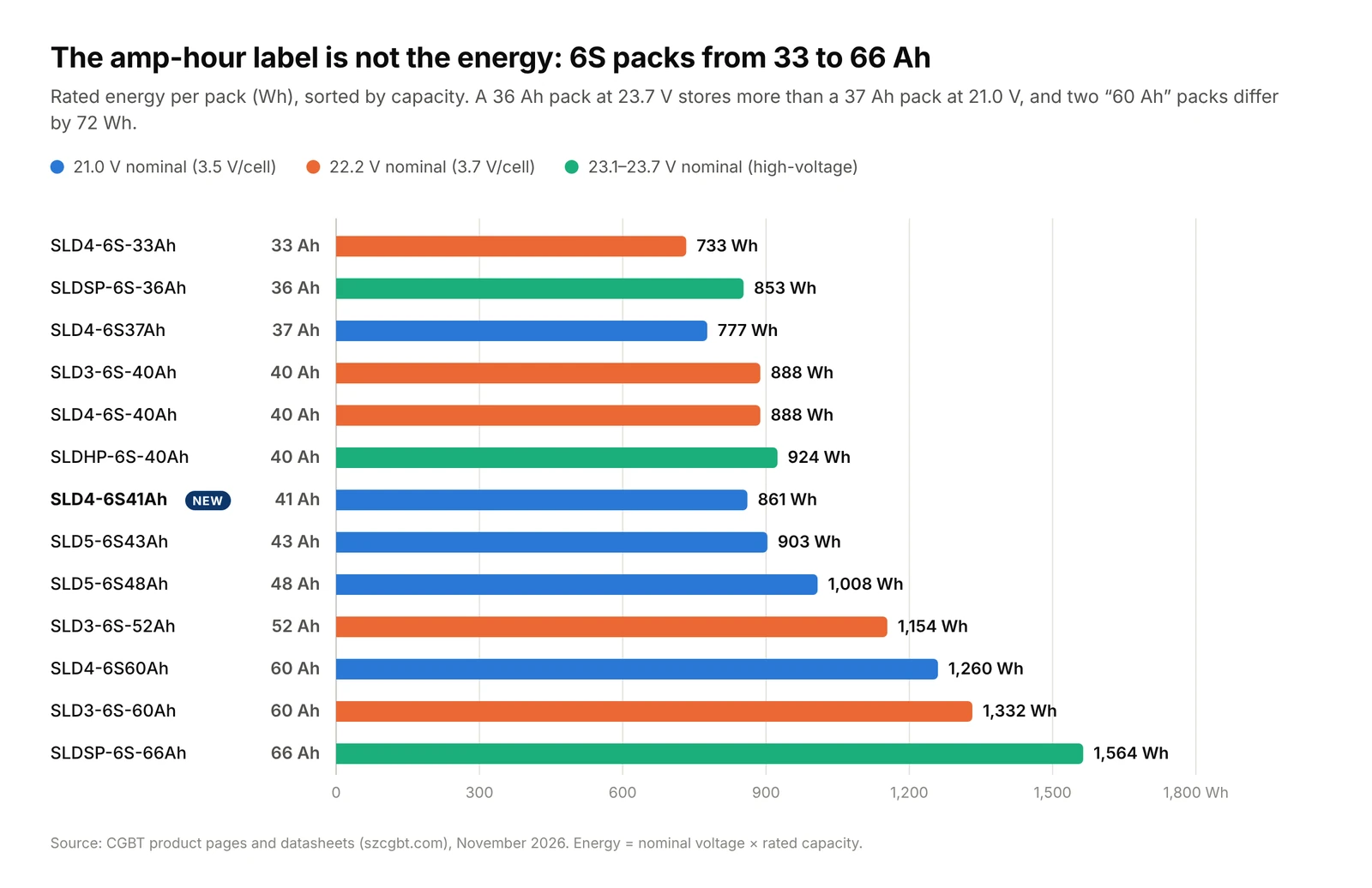
The spread between the first and last row is 178 Wh, or about 13%, with no change in the mAh figure. The same effect runs through the whole 33–66 Ah range: in Figure 1, a 36 Ah pack stores more energy than a 37 Ah pack, and two packs that are both sold as “60 Ah” differ by 72 Wh.
Nominal voltage also tells you which charger profile and which low-voltage settings the pack needs. Our 21.0 V packs charge to 25.8 V (4.3 V per cell) and may be discharged to 15 V, or 12 V below 0 °C. Other voltage families have different limits, so always set chargers and failsafes from the datasheet of the actual pack.
Step 1: Confirm that 6S is the right voltage
The series count is decided by the motors and ESCs, not by the battery. 6S systems are common on mapping and inspection multirotors, fixed-wing VTOL aircraft and mid-size utility frames. DeltaQuad’s Evo fixed-wing VTOL is a good reference point: its published specification lists 6-cell, 22 Ah semi-solid-state lithium-ion batteries and up to 272 minutes of flight on a dual-battery setup at a 10 kg maximum take-off weight, under the manufacturer’s stated conditions.
Before going further, check two things on your own aircraft:
- Maximum input voltage. A fully charged 21.0 V semi-solid pack sits at 25.8 V, 0.6 V above a standard 6S LiPo at 25.2 V. Make sure the ESCs, power module and any payload regulator are rated for it.
- Low-voltage settings. A semi-solid pack with a 21.0 V nominal voltage delivers much of its energy below the voltages a LiPo operator is used to. A failsafe left at 3.5 V per cell (21.0 V) would trigger around the middle of the discharge. Reset alarm and failsafe thresholds from the datasheet and from your own discharge logs.
If your aircraft needs several kilowatts in normal flight, the current at 6S becomes hard to manage, and the better answer is usually more voltage, not more amp-hours. Our guide to 12S, 14S, 18S and 24S heavy-lift batteries covers that decision.
Step 2: Size the pack in watt-hours
Start from the mission, not from the catalogue. Estimate average electrical power from flight logs or from the propulsion supplier’s thrust tables, multiply by the flight time you need including reserve, and divide by the share of the pack you plan to use.
Required energy (Wh) = average power (W) × flight time (h) ÷ usable fraction
Required capacity (Ah) = required energy (Wh) ÷ nominal pack voltage (V)
We plan on 80% of rated energy. That leaves a landing reserve and is kinder to the cells: Battery University’s cycle-life tables for conventional NMC lithium-ion estimate roughly 300 cycles at 100% depth of discharge, 400 at 80% and 600 at 60%. Treat those figures as a direction of travel for semi-solid cells, not a prediction, but the direction is the same. Derate further in winter; see our guide to drone batteries in cold weather.
Worked numbers. A drone that averages 800 W and needs 60 minutes, using 80% of rated energy, needs 800 × 1.0 ÷ 0.8 = 1,000 Wh. That is 47.6 Ah at 21.0 V, 45.0 Ah at 22.2 V or 42.2 Ah at 23.7 V. The energy requirement is the same in every case; only the label changes.
Step 3: Weigh the pack, because weight costs flight time
Every pack you add also has to be lifted. This is the step most buyers skip, and it is where the “biggest mAh wins” assumption breaks down. Figure 2 plots each of our 6S packs in this range by weight and energy. The grey guides are lines of equal pack-level specific energy, from 250 to 450 Wh/kg.
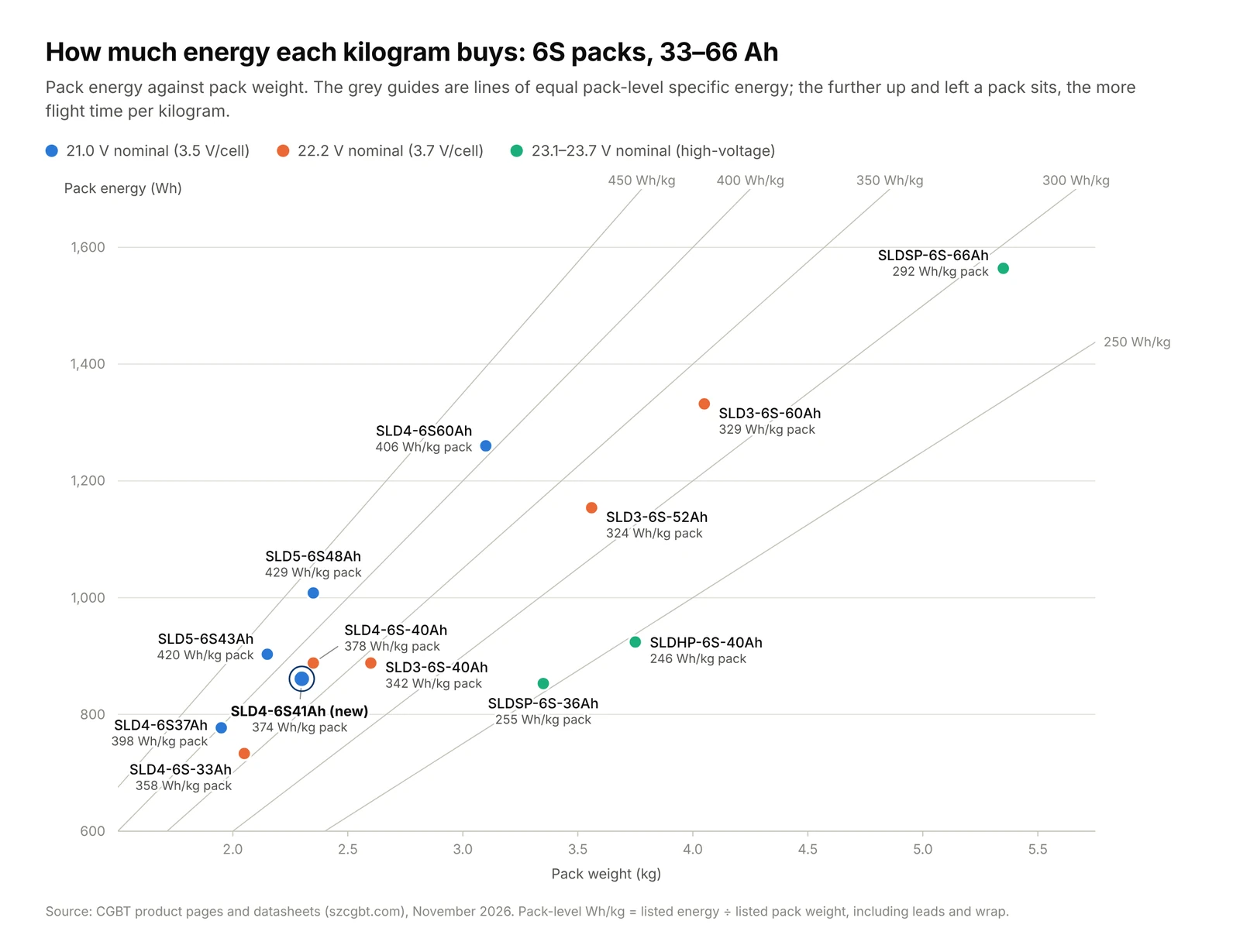
Read the chart from left to right at a fixed energy. Around 900 Wh, for example, you can choose a 2.15 kg pack (SLD5-6S43Ah), a 2.3 to 2.35 kg pack (the new SLD4-6S41Ah or the SLD4-6S-40Ah), a 2.6 kg pack (SLD3-6S-40Ah) or a 3.75 kg pack (SLDHP-6S-40Ah). The heavier options are not worse batteries. They deliver more current, as Step 4 shows. But the weight has to be paid for. Note that these are pack-level figures, which sit a few percent below the cell rating; our article on cell vs pack energy density explains the gap.
Why the last kilogram of battery buys the least
A rotor that has to produce more thrust does so less efficiently. That is basic rotor physics, and it shows up clearly in manufacturers’ bench data. Figure 3 uses T-Motor’s published test table for the U8II KV150, run on 6S with a 30-inch propeller: efficiency falls from 17.0 g of thrust per watt at 1.55 kg per rotor to 12.8 g/W at 2.8 kg and 8.3 g/W at full throttle.
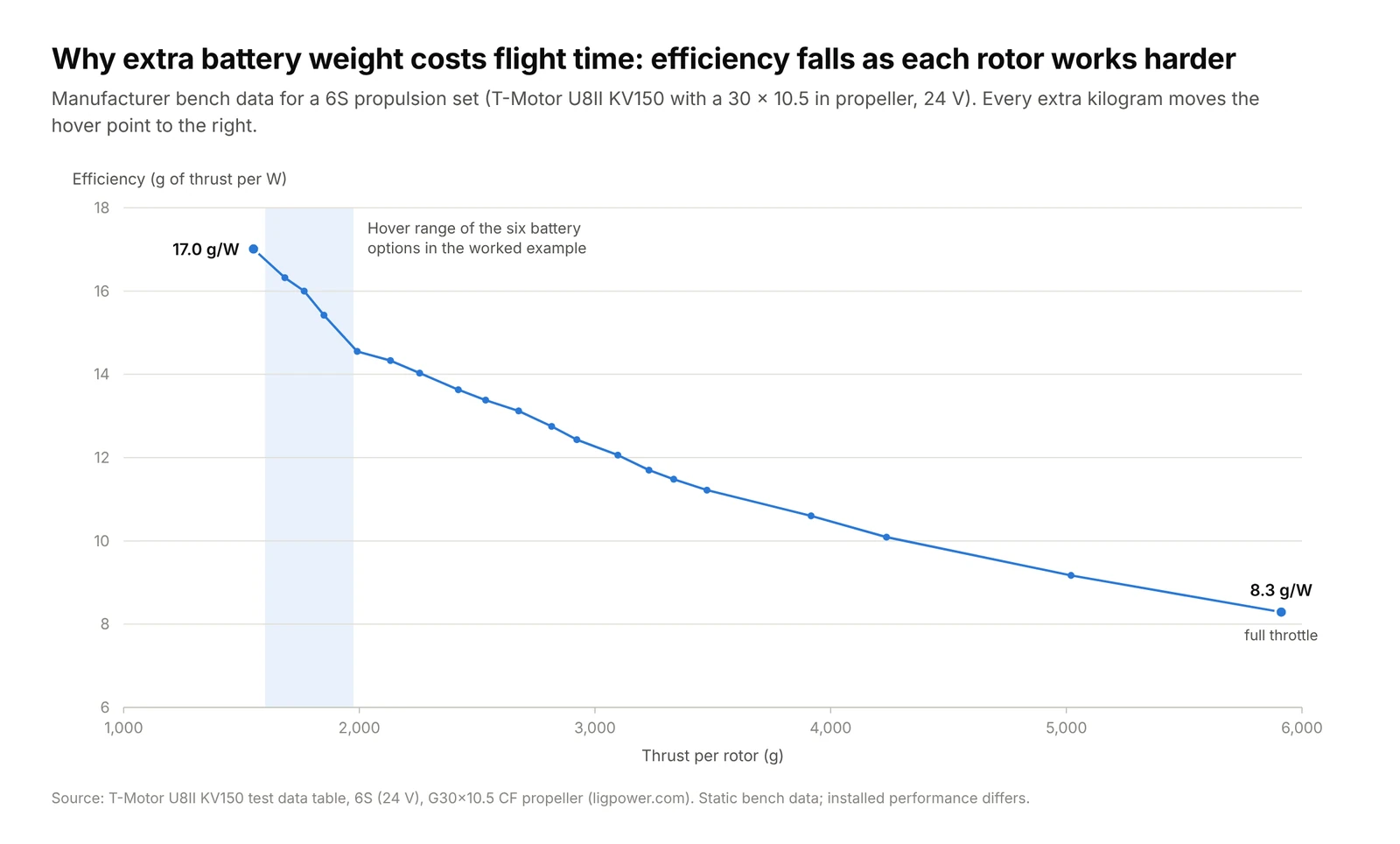
The research literature reaches the same conclusion from theory and flight tests. Gatti, Giulietti and Turci (2015) derive hover endurance as a function of airframe, rotor and battery capacity, and obtain the capacity that gives the longest hover time. Beyond that optimum, extra battery no longer adds endurance. Hwang, Cha and Jung (2018) estimate multirotor endurance from manufacturer thrust data, the same approach we use below, and report an average error of 2.3% against measured flights. In their results, a payload equal to the vehicle’s own weight cut endurance from 22.2 to 9.3 minutes. Our own article on turning Wh/kg into flight time looks at the same trade-off from the cell side.
Worked example: six battery choices on one hexacopter
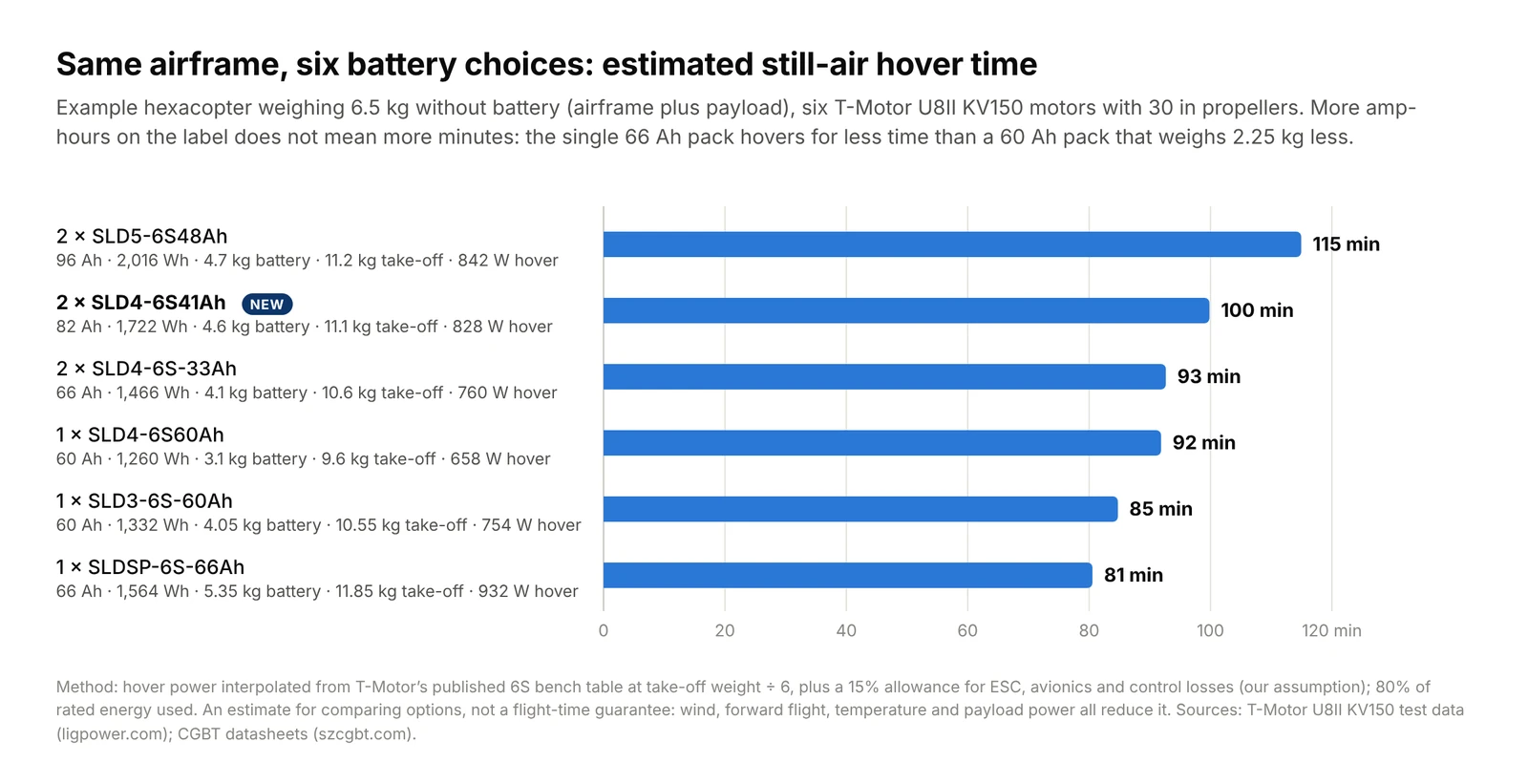
Take a hexacopter that weighs 6.5 kg without its battery (airframe plus payload) and uses six U8II KV150 motors with 30-inch propellers. We fitted six different battery options on paper, divided take-off weight by six to get the thrust per rotor, read hover power from T-Motor’s table, added a 15% allowance for ESC, avionics and control losses, and used 80% of rated energy. Every option stays within the 12 kg take-off weight T-Motor lists for a hexacopter on this motor.
| Battery option | Capacity | Energy | Battery weight | Take-off weight | Hover power | Estimated hover |
|---|---|---|---|---|---|---|
| 2 × SLD5-6S48Ah in parallel | 96 Ah | 2,016 Wh | 4.7 kg | 11.2 kg | ≈842 W | 115 min |
| 2 × SLD4-6S41Ah in parallel (new) | 82 Ah | 1,722 Wh | 4.6 kg | 11.1 kg | ≈828 W | 100 min |
| 2 × SLD4-6S-33Ah in parallel | 66 Ah | 1,466 Wh | 4.1 kg | 10.6 kg | ≈760 W | 93 min |
| 1 × SLD4-6S60Ah | 60 Ah | 1,260 Wh | 3.1 kg | 9.6 kg | ≈658 W | 92 min |
| 1 × SLD3-6S-60Ah | 60 Ah | 1,332 Wh | 4.05 kg | 10.55 kg | ≈754 W | 85 min |
| 1 × SLDSP-6S-66Ah | 66 Ah | 1,564 Wh | 5.35 kg | 11.85 kg | ≈932 W | 81 min |
Three results are worth remembering:
- More energy gives diminishing returns. Going from one SLD4-6S60Ah (1,260 Wh) to two SLD5-6S48Ah (2,016 Wh) adds 60% more energy but only 25% more hover time, because the aircraft is 1.6 kg heavier and each rotor works at lower efficiency.
- The largest single pack hovers for the shortest time. The 66 Ah pack carries 24% more energy than the SLD4-6S60Ah, yet it weighs 2.25 kg more and hovers 11 minutes less on this airframe. Its strength lies elsewhere: at 198 A it has the highest continuous rating of the six.
- Two 33 Ah packs beat one 66 Ah pack on endurance. Both are “66 Ah” on paper. The pair built on 400 Wh/kg cells is 1.25 kg lighter and hovers about 12 minutes longer.
These are still-air hover estimates built from static bench data, intended for comparing options. They are not flight-time guarantees. Wind, forward flight, temperature, payload power draw and battery age all reduce real endurance. Run the same calculation with your own logged hover power for a figure you can plan a mission on.
Step 4: Check continuous and peak discharge
C-rate expresses current relative to capacity: 1C on a 41 Ah pack is 41 A. A drone battery has to meet two ratings, the continuous rating against hover and cruise current, and the peak rating against take-off, climbs and gust corrections. Figure 5 shows both for every pack in this range.
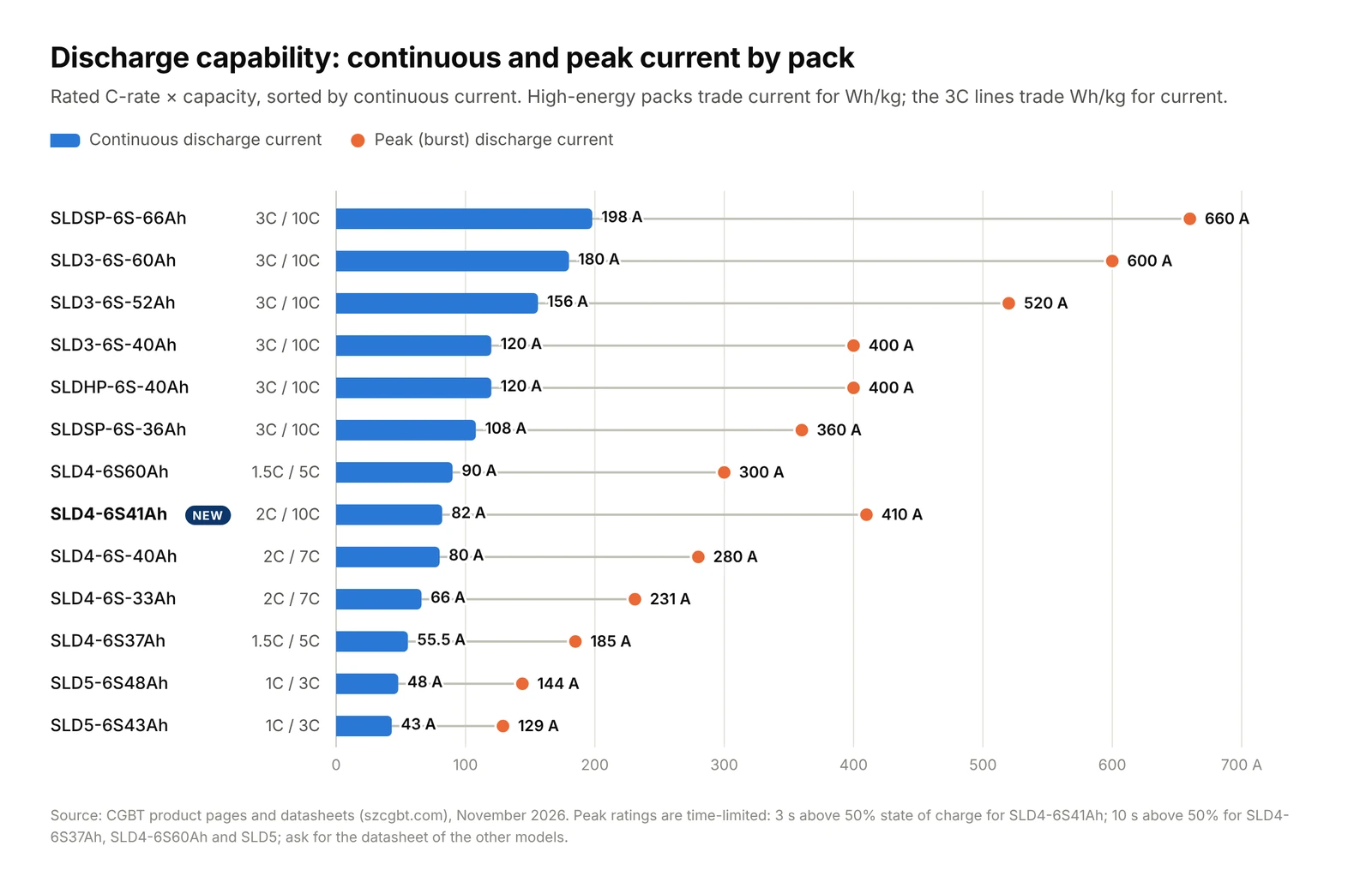
The pattern is consistent across the range. The highest-energy cells (SLD5, 450–460 Wh/kg) are rated 1C continuous and 3C peak. The SLD4 packs sit at 1.5C to 2C. The SLD3 and SLDHP/SLDSP lines are rated 3C continuous and 10C peak, and they are heavier per watt-hour as a result.
Back to the example hexacopter. In hover it draws 31 to 40 A in total, which is only 0.4C to 0.6C for any of the six options, so every pack is comfortable. Full throttle is a different matter: T-Motor’s table shows 29.7 A per motor at 100% throttle, or about 178 A for six motors.
- Two SLD5-6S48Ah in parallel are rated 96 A continuous and 288 A peak for 10 seconds. Full throttle is available as a short burst, not as a sustained climb.
- Two SLD4-6S41Ah in parallel are rated 164 A continuous and 820 A peak for 3 seconds, enough to cover almost all of the envelope continuously.
- The SLD3-6S-60Ah (180 A) and SLDSP-6S-66Ah (198 A) cover full throttle continuously from a single pack.
So the right pack depends on how the aircraft flies. An endurance platform that cruises gently can use the lightest cells. A drone that lifts a heavy payload, climbs hard or holds position in strong wind should give up some Wh/kg for a 3C pack. A pack that runs well below its continuous rating in normal flight also sags less and stays cooler, which helps both end-of-flight voltage margin and cycle life.
Do not forget the connector. Amass, which makes the XT series, gives a rated current of 45 A for XT90-series connectors in its own datasheets. A single pack that will carry much more than that for minutes at a time should be ordered with a larger connector, or the current should be split across two packs. Our UAV battery connector guide covers the options.
Step 5: One big pack or two smaller ones?
Connecting two packs in parallel adds their amp-hours while the voltage stays the same, as Battery University’s guide to series and parallel configurations explains. For capacities of 66 Ah and above, a parallel pair is often the stronger design:
- Access to lighter cells. Our highest-energy cells are built into packs of 37 to 60 Ah. Two of them give 74 to 120 Ah at roughly 400 to 430 Wh/kg at pack level.
- Shared current. Each pack, lead and connector carries half the load.
- A second power path. With a suitable power distribution design, the aircraft can still land if one pack or connector fails. Dual-battery layouts are used on professional aircraft such as the DeltaQuad Evo mentioned above.
- Easier handling and transport. Two 2.3 kg packs are easier to fit around the centre of gravity, and to ship, than one 5 kg block.
A single pack has its own advantages: one connector to plug in, one battery to charge and log, no balancing between packs, and usually a simpler battery bay. If you do run packs in parallel, use the same model, the same age and cycle count, and the same state of charge at connection. Battery University’s guide makes the same point for cells: they must be matched, especially under heavy loads. The BMS and protection design should be specified for parallel use from the start.
Step 6: Charging, cycle life and cost per flight
Purchase price is only part of the cost of a battery. How quickly it turns around and how many flights it delivers matter just as much for a working fleet.
- Charge rate. Our highest-energy 6S packs (SLD4-6S37Ah, SLD4-6S60Ah, SLD5) are rated for charging at 0.5C. The new SLD4-6S41Ah accepts 1C, or 41 A, which roughly halves the constant-current part of the charge.
- Charger current. Charging a 41 Ah pack at 1C needs just over 40 A at 6S, more than a 25 A or 30 A charger can supply. In our UAV charger range, the EV-PEAK UD1 is listed at 60 A for 6S to 14S packs.
- Charge voltage. Set the charger to the cut-off voltage on the datasheet. For our 21.0 V packs that is 25.8 V (4.3 V per cell). A standard LiPo profile stops at 25.2 V and leaves capacity unused; a LiHV profile at 4.35 V per cell goes to 26.1 V, which is above the limit and must not be used. Ask us to confirm the profile for your charger model.
- Cycle life. The SLD4-6S41Ah is rated for 500 cycles, against 300 for the SLD4-6S37Ah, SLD4-6S60Ah and SLD5 packs. Multiplying rated energy by rated cycles gives a rough lifetime figure: about 430 kWh for the SLD4-6S41Ah against about 302 kWh for the SLD5-6S48Ah. For a drone that flies several times a day, that difference can outweigh a few minutes of endurance per flight.
New: SOARLID SLD4-6S41Ah, a 41,000 mAh pack for daily work
The SLD4-6S41Ah is the newest 6S pack in our SLD4 semi-solid-state family. It is built on 390 Wh/kg cells and is designed for operators who want long flights without giving up fast charging, burst power and service life.
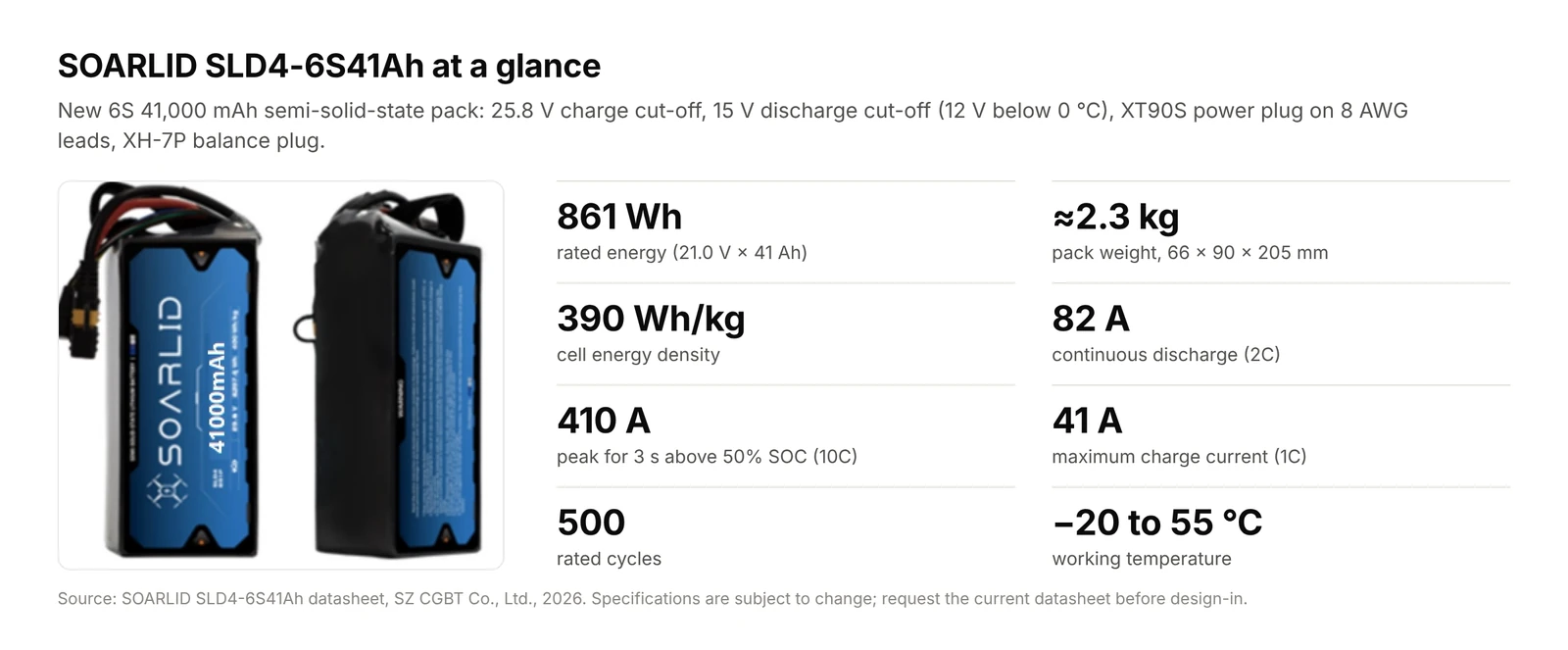
| SLD4-6S37Ah | SLD4-6S41Ah (new) | SLD5-6S43Ah | SLD5-6S48Ah | |
|---|---|---|---|---|
| Cell energy density | 436 Wh/kg | 390 Wh/kg | 450 Wh/kg | 460 Wh/kg |
| Energy (21.0 V nominal) | 777 Wh | 861 Wh | 903 Wh | 1,008 Wh |
| Pack weight | ≈1.95 kg | ≈2.3 kg | ≈2.15 kg | ≈2.35 kg |
| Continuous discharge | 55.5 A (1.5C) | 82 A (2C) | 43 A (1C) | 48 A (1C) |
| Peak discharge (above 50% SOC) | 185 A (5C), 10 s | 410 A (10C), 3 s | 129 A (3C), 10 s | 144 A (3C), 10 s |
| Maximum charge current | 18.5 A (0.5C) | 41 A (1C) | 21.5 A (0.5C) | 24 A (0.5C) |
| Rated cycle life | 300 cycles | 500 cycles | 300 cycles | 300 cycles |
| Size (±5 mm) | 66 × 78 × 190 mm | 66 × 90 × 205 mm | 60 × 91 × 205 mm | 65 × 91 × 205 mm |
Compared with the SLD5 packs of similar size, the SLD4-6S41Ah stores slightly less energy. In return it delivers nearly twice the continuous current, charges at twice the C-rate and is rated for two-thirds more cycles. Its envelope is also close to that of the SLD5-6S43Ah, SLD5-6S48Ah, SLD4-6S-40Ah and SLD3-6S-40Ah (roughly 60–70 × 90 × 205 mm), so one battery bay can usually accept an endurance pack for long survey days and a higher-power pack for payload work.
The reference build has 150 mm 8 AWG power leads with an XT90S anti-spark plug and an XH-7P balance plug. It charges to 25.8 V, discharges to 15 V (12 V below 0 °C) and is rated to work from −20 to 55 °C. Leads, connectors, case and BMS protocol can be customised. Contact us for the SLD4-6S41Ah datasheet and sample availability.
CGBT 6S packs from 33 to 66 Ah at a glance
| Model | Nominal voltage | Capacity | Energy | Weight | Pack-level Wh/kg | Cell Wh/kg | Continuous / peak | Size (mm) |
|---|---|---|---|---|---|---|---|---|
| SLD4-6S-33Ah | 22.2 V | 33 Ah | 733 Wh | 2.05 kg | 358 | 400 | 2C / 7C | 70 × 78 × 195 |
| SLDSP-6S-36Ah | 23.7 V | 36 Ah | 853 Wh | 3.35 kg | 255 | 270 | 3C / 10C | 72 × 108 × 235 |
| SLD4-6S37Ah | 21.0 V | 37 Ah | 777 Wh | 1.95 kg | 398 | 436 | 1.5C / 5C | 66 × 78 × 190 |
| SLD3-6S-40Ah | 22.2 V | 40 Ah | 888 Wh | 2.6 kg | 342 | 350 | 3C / 10C | 70 × 90 × 205 |
| SLD4-6S-40Ah | 22.2 V | 40 Ah | 888 Wh | 2.35 kg | 378 | 400 | 2C / 7C | 70 × 90 × 205 |
| SLDHP-6S-40Ah | 23.1 V | 40 Ah | 924 Wh | 3.75 kg | 246 | 260 | 3C / 10C | 78 × 110 × 230 |
| SLD4-6S41Ah (new) | 21.0 V | 41 Ah | 861 Wh | 2.3 kg | 374 | 390 | 2C / 10C | 66 × 90 × 205 |
| SLD5-6S43Ah | 21.0 V | 43 Ah | 903 Wh | 2.15 kg | 420 | 450 | 1C / 3C | 60 × 91 × 205 |
| SLD5-6S48Ah | 21.0 V | 48 Ah | 1,008 Wh | 2.35 kg | 429 | 460 | 1C / 3C | 65 × 91 × 205 |
| SLD3-6S-52Ah | 22.2 V | 52 Ah | 1,154 Wh | 3.56 kg | 324 | 350 | 3C / 10C | 63 × 125 × 245 |
| SLD3-6S-60Ah | 22.2 V | 60 Ah | 1,332 Wh | 4.05 kg | 329 | 350 | 3C / 10C | 70 × 125 × 245 |
| SLD4-6S60Ah | 21.0 V | 60 Ah | 1,260 Wh | 3.1 kg | 406 | 433 | 1.5C / 5C | 53 × 135 × 225 |
| SLDSP-6S-66Ah | 23.7 V | 66 Ah | 1,564 Wh | 5.35 kg | 292 | 300 | 3C / 10C | 60 × 168 × 255 |
Pack-level Wh/kg is our calculation from the listed energy and weight. Outside this range we also build 6S packs from 12.5 Ah up to the SLD4-6S80Ah.
Which pack for which job
- Longest endurance at gentle current (fixed-wing VTOL cruise, mapping and inspection, long-range multirotors): SLD5-6S43Ah, SLD5-6S48Ah, SLD4-6S37Ah or SLD4-6S60Ah, singly or in pairs. The SLD4-6S60Ah is also listed for discharge down to −40 °C.
- Endurance with fast turnaround and burst power (daily commercial operations, mixed hover and transit, light delivery): SLD4-6S41Ah, SLD4-6S-33Ah or SLD4-6S-40Ah.
- High continuous current (heavy payloads, aggressive climbs, lifting and delivery work): SLD3-6S-40Ah, SLD3-6S-52Ah, SLD3-6S-60Ah, SLDHP-6S-40Ah, or the SLDSP-6S-66Ah when you want 66 Ah and close to 200 A from one pack.
For background on how these chemistries differ from conventional LiPo, see semi-solid vs solid-state vs LiPo drone batteries.
Shipping and storage notes
Every pack in this range is far above 100 Wh, so it travels as fully regulated Class 9 dangerous goods (UN 3480). Under the 2026 IATA lithium battery guidance, lithium-ion batteries shipped on their own go on cargo aircraft only, at a state of charge of no more than 30%, with a limit of 35 kg net per package, and the manufacturer must make a UN 38.3 test summary available. Expect packs to arrive partly charged and plan a full charge and balance before first use. Ask your supplier for the UN 38.3 test summary and safety data sheet before booking freight. We deliver worldwide, including DDP.
For storage, follow the datasheet. The SLD4-6S41Ah, for example, is specified for storage between −20 and 35 °C at less than 85% relative humidity. In line with general lithium-ion practice, store packs partly charged, not full and not empty, and check voltage periodically.
Quick selection checklist
- Confirm that your motors, ESCs and power module are designed for 6S and can accept the pack’s full-charge voltage.
- Work out the energy you need in watt-hours from average power, flight time and an 80% usable fraction.
- Shortlist packs by energy, then compare weight and pack-level Wh/kg, not mAh.
- Recalculate hover power at the new take-off weight. Do not assume that double the energy gives double the time.
- Check hover current against the continuous rating and maximum current against the peak rating and its time limit.
- Decide between one pack and a matched parallel pair, and size connectors for the current each one carries.
- Check charge current, charge cut-off voltage and charger compatibility, then compare rated cycle life.
- Agree on connectors, BMS protocol, shipping terms and documentation with your supplier.
If you would like a second opinion, send us your motor and propeller model, take-off weight without battery, and target flight time. Our engineers will run the numbers and recommend a pack or a parallel pair, with datasheets. You can also see how the packs are built on our manufacturing page.
Frequently asked questions
How many watt-hours is a 66,000 mAh 6S battery?
It depends on the nominal voltage of the cells. 66 Ah is 1,386 Wh at 21.0 V, 1,465 Wh at 22.2 V and 1,564 Wh at 23.7 V. Our SLDSP-6S-66Ah is a 23.7 V pack and stores 1,564 Wh.
Is one 66 Ah pack better than two 33 Ah packs in parallel?
Not automatically. Two packs in parallel give the same amp-hours, share the current and add a second power path, and they can use lighter high-energy cells. In our worked example, two SLD4-6S-33Ah packs weighed 1.25 kg less than one SLDSP-6S-66Ah and hovered about 12 minutes longer. A single 66 Ah pack is simpler to install and, in our range, delivers more continuous current.
How long will a 6S 41 Ah battery fly my drone?
Multiply rated energy by the usable fraction and divide by your average power. The SLD4-6S41Ah stores 861 Wh, so about 689 Wh at 80% use. A drone that averages 700 W would fly for roughly 59 minutes, and one that averages 1,400 W for roughly 30 minutes, in still air with a healthy pack.
Can I charge a semi-solid-state 6S battery with a LiPo charger?
Only if the charger can be set to the pack’s charge cut-off voltage and current. Our 21.0 V packs charge to 25.8 V (4.3 V per cell). A standard 25.2 V LiPo profile undercharges them, and a 26.1 V LiHV profile exceeds the limit and must not be used. The balance connector on our reference builds is an XH-7P.
What is the difference between a 21.0 V and a 22.2 V 6S pack?
Both have six cells in series and run the same 6S propulsion systems. They use cells with different nominal voltages (3.5 V and 3.7 V), so they store different energy per amp-hour and need different charger and low-voltage settings. Always follow the datasheet of the specific pack.
Can high-capacity 6S drone batteries be shipped by air?
Yes, as Class 9 dangerous goods on cargo aircraft, at no more than 30% state of charge and with UN 38.3 test documentation, under the current IATA rules. Other transport modes have their own dangerous-goods requirements, so confirm the route with your supplier and forwarder.