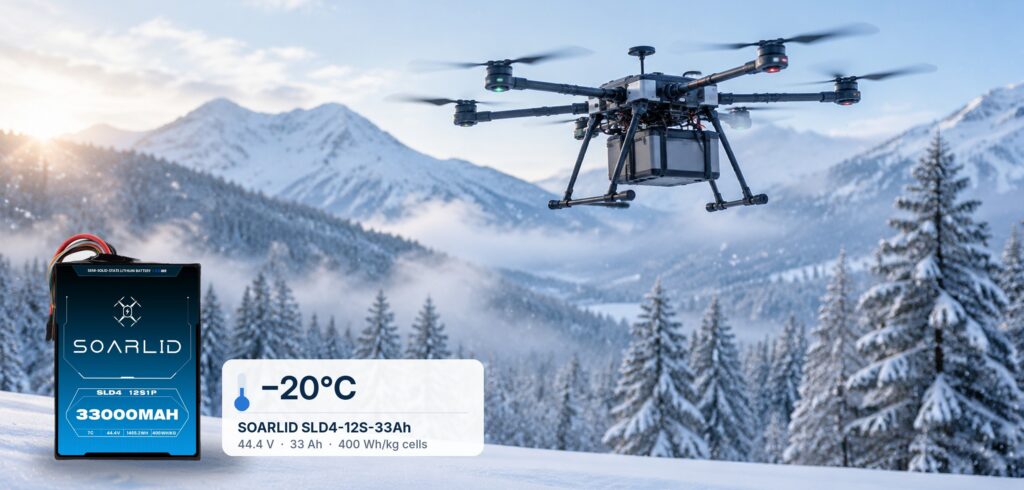
Cold does not drain a drone battery. It makes the energy harder to get out. Here is what happens inside the pack in winter, how much flight time to expect, and what operators and drone makers can do about it.
Key takeaways
- Cold raises a battery’s internal resistance and lowers its usable capacity. The loss is temporary and returns at room temperature.
- As a general rule for batteries, expect roughly half the rated performance at −20°C unless the pack is built and rated for cold.
- The first minutes of a flight are the riskiest. Pre-warm packs to above 15°C and hover for about a minute before the mission.
- Never charge a lithium pack below 0°C. It causes lithium plating, which is permanent.
- A temperature rating is not a capacity figure. Ask your supplier for measured capacity at your lowest operating temperature.
Why cold cuts flight time
A lithium battery moves ions through an electrolyte between two electrodes. When the temperature falls, the electrolyte thickens and the reactions at the electrodes slow down. Battery University describes the result plainly: cold temperature increases the internal resistance and lowers the capacity [1]. For a drone, that shows up in three ways.
1. Voltage sag under load
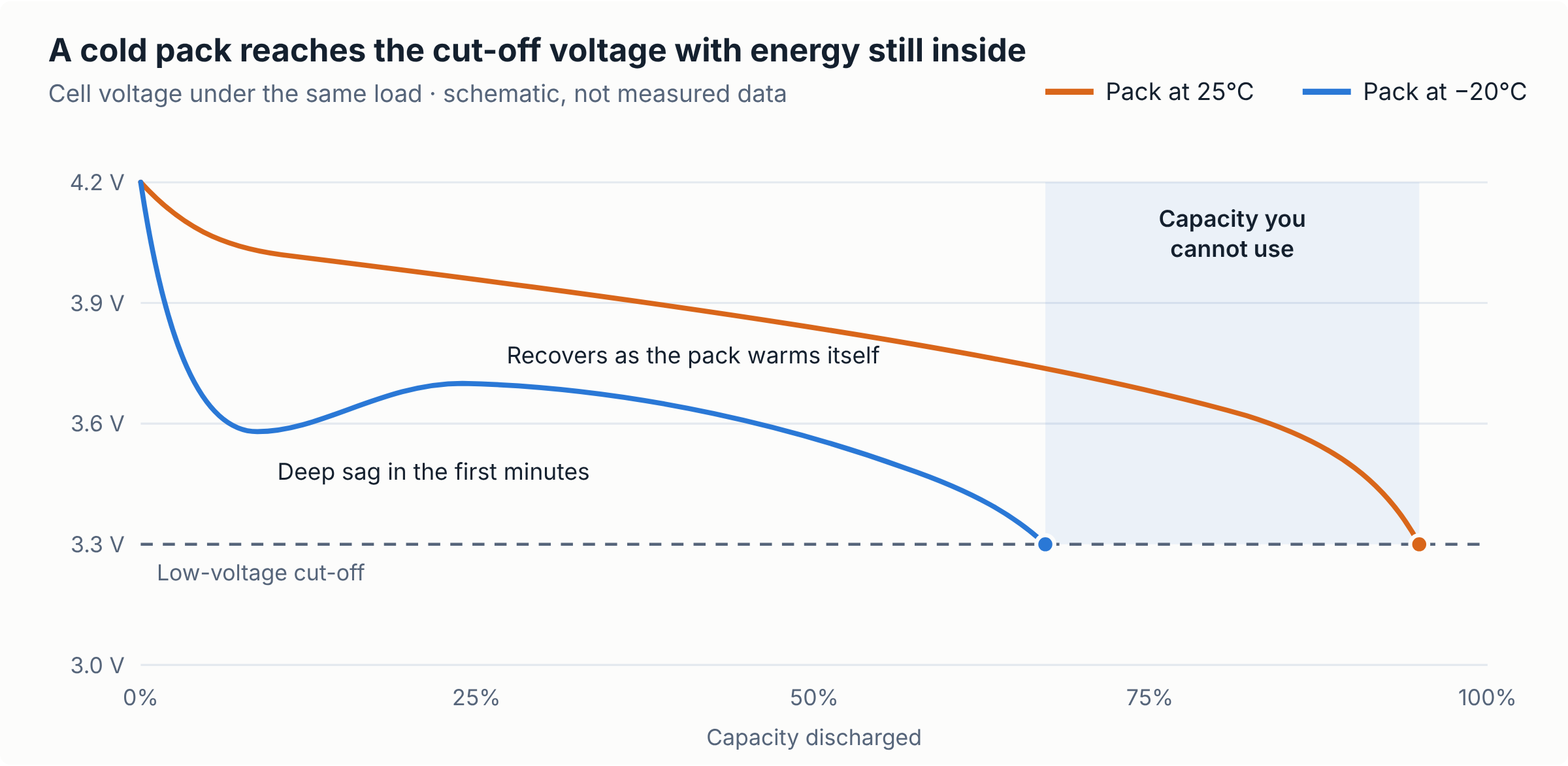
Every amp the motors draw causes a voltage drop across the pack’s internal resistance. If cold doubles that resistance, the drop doubles too. Multirotors draw high current continuously, so a cold pack can reach the flight controller’s low-voltage threshold while most of its energy is still inside. DJI warns that once a single cell falls below 3 V, the aircraft may not hold speed at maximum thrust and the risk of power failure rises [3].
2. Less usable capacity
Because the pack hits its cut-off voltage earlier, the capacity you can actually use shrinks. Nothing has leaked away. Research by Heliguy with Northumbria University found that batteries stored cold kept their charge, but delivered power dropped significantly in flight, mostly in the first five minutes [4].
3. Partial recovery as the pack heats itself
The same resistance that causes sag also turns some energy into heat. A pack under load warms itself, and its voltage recovers a little after the first minutes. That is why the start of a winter flight is the most dangerous part, and why a short warm-up hover matters.
How much flight time will you lose?
There is no single answer, because it depends on the cell chemistry, the discharge rate and how well the pack holds its own heat. A few reference points help set expectations.
- General batteries. Battery University gives a rule of thumb that most batteries deliver about 50% of their performance at −20°C [1].
- Standard lithium-ion. The usual discharge window is −20°C to 60°C. Some specialty cells work down to −40°C, but only at a reduced discharge rate [1].
- Semi-solid-state. Many semi-solid packs are rated to discharge at −20°C and some to −40°C, as covered in our comparison of semi-solid, solid-state and LiPo drone batteries.
Treat these as planning figures, and remember that a rating only tells you the pack will work at that temperature. It does not tell you how many amp-hours you will get. Our article on cell versus pack energy density explains the same gap between a headline number and what reaches the motors.
The temperature windows that matter
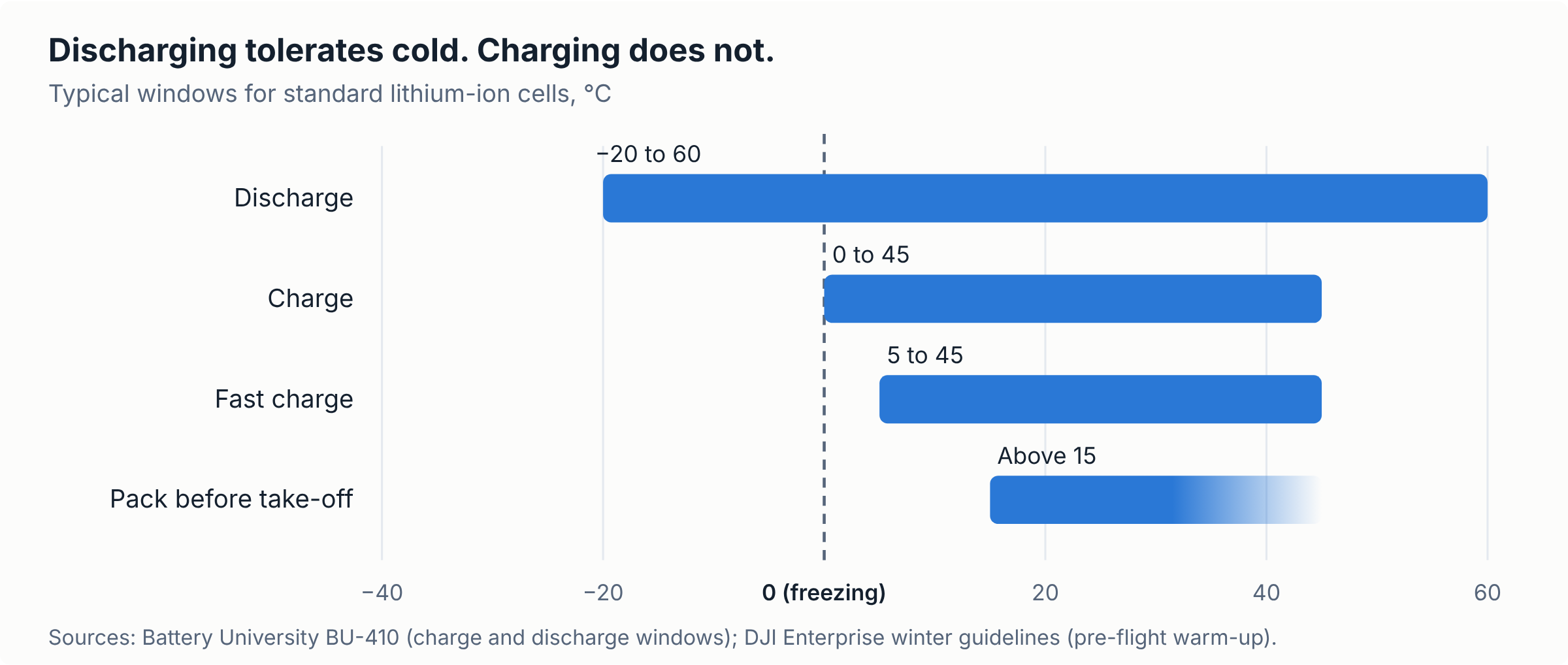
Four temperature limits cover most winter decisions. The figure below puts them on one scale.
| Situation | Guideline | Why |
|---|---|---|
| Discharging in flight | Down to −20°C for standard cells, lower for cold-rated packs | Capacity and voltage fall as temperature drops |
| Charging | 0°C to 45°C. Below 5°C, reduce charge current | Lithium plating below freezing damages the cell permanently |
| Before take-off | Pack warmed to above 15°C | Lower internal resistance at the moment of highest demand |
| Storage between jobs | Dry, indoors, around 5°C to 20°C | Avoids deep cold soak and condensation |
Guidelines drawn from Battery University [2] and DJI Enterprise [3]. The storage range is DJI’s recommendation for storing the aircraft.
Seven field practices that protect winter flight time
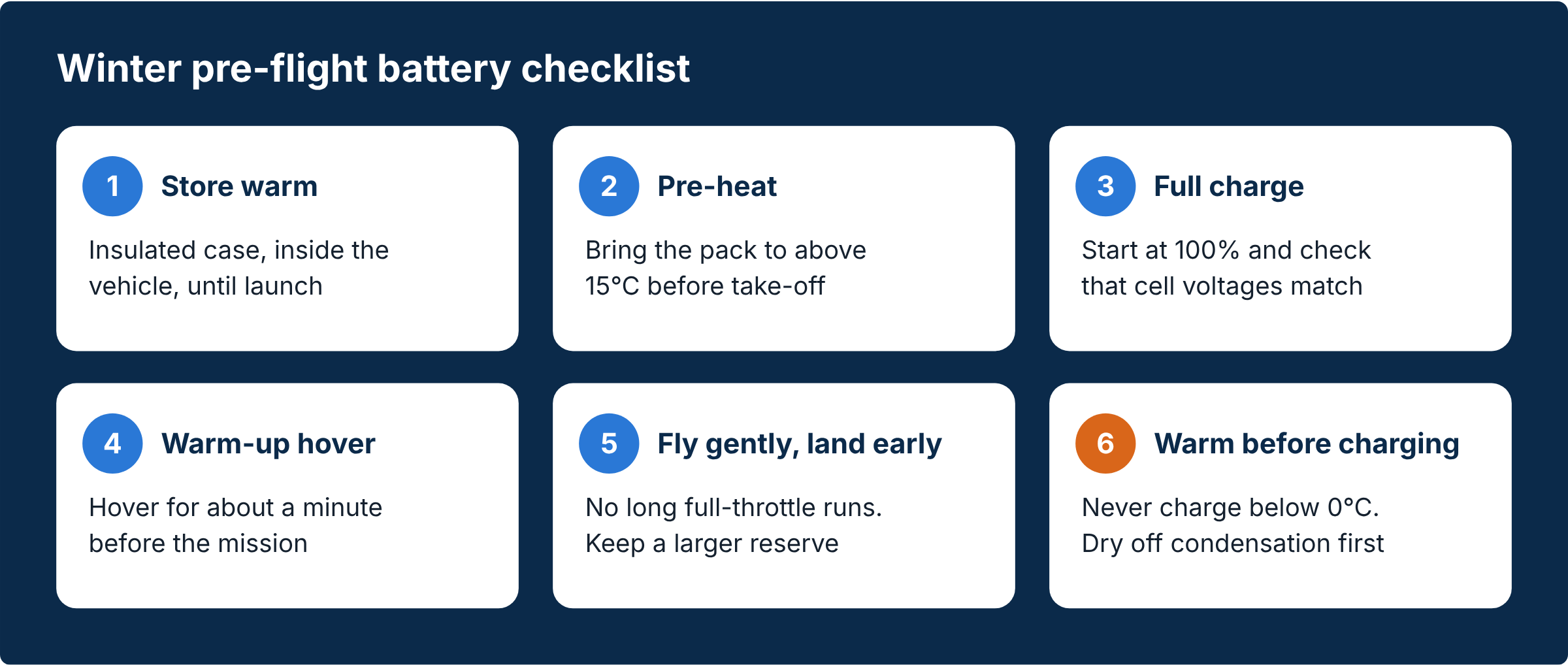
- Keep packs warm until launch. Transport them in an insulated case inside the vehicle, not in the truck bed. Take each pack out only when you are ready to fly.
- Pre-heat to above 15°C. Use a battery heater or a warm box. DJI recommends this threshold because it lowers internal resistance before the first throttle-up [3].
- Launch with a full charge. A partly charged pack starts closer to the cut-off voltage and has less room for sag.
- Hover for about a minute. Let the pack warm itself under a light load and watch cell voltages before you climb or load up.
- Fly gently. Avoid long periods at full throttle and hard climbs. Current spikes are what push a cold cell below 3 V.
- Land earlier. Keep a larger reserve than in summer. Until you have your own winter flight logs, plan missions well short of the summer endurance.
- Dry everything afterwards. Moving from cold air into a warm room causes condensation on packs and connectors. Wipe them down, and check the contacts. Our guide to choosing a UAV battery connector covers what to look for.
Never charge a cold pack
Discharging in the cold costs you flight time for that day. Charging in the cold can cost you the battery. Below 0°C, lithium ions cannot enter the anode fast enough and deposit on its surface as metal instead. Battery University notes that the pack appears to charge normally while this happens, and that the damage is permanent and makes the cell less safe [2].
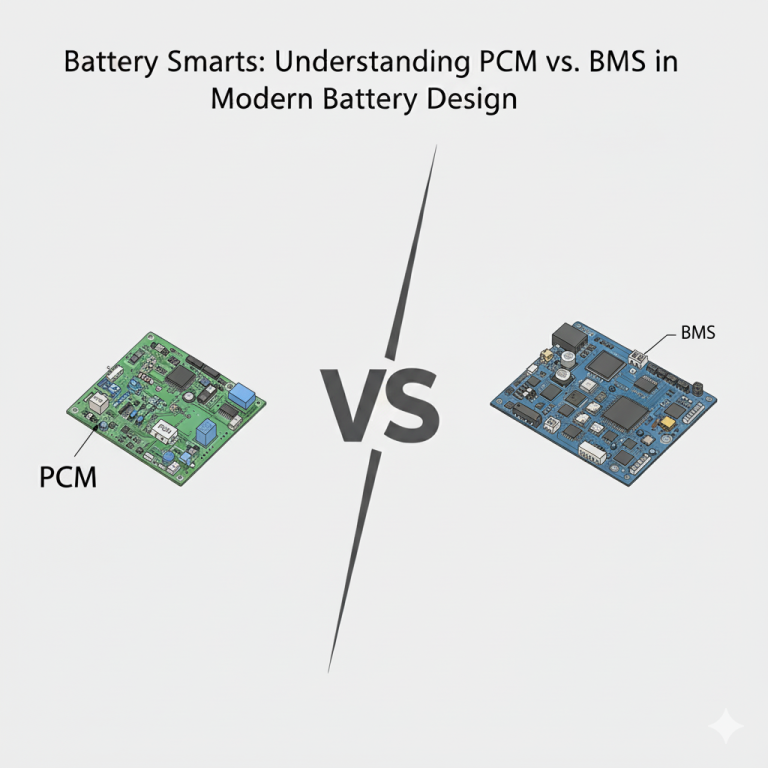
The rule for field teams is simple. Bring packs above freezing before they go on the charger, and reduce the charge current if the pack is below 5°C. A smart BMS with temperature sensing can enforce this by blocking charge when the cells are too cold. If you are unsure what your pack’s electronics do, our explainer on PCM versus BMS shows the difference. For chargers sized for 6S to 24S industrial packs, see our UAV charger range.
Choosing a battery for winter operations
Operating practice only goes so far. If your fleet works through winters in Eastern or Northern Europe, at altitude, or on mountain rescue, the pack itself has to be chosen for the cold.
Cell chemistry
Semi-solid-state cells replace part of the liquid electrolyte with a solid or gel component. CGBT’s semi-solid-state batteries keep strong discharge performance below −20°C, and several SLD4 packs are rated down to −40°C. The same cells reach 350 to 460 Wh/kg, so even after cold losses there is more energy left to work with than in a conventional LiPo pack of the same weight.
Discharge-rate margin
A pack running close to its maximum continuous rate in summer has no room for the extra sag in winter. Size the pack so that cruise current sits well below its continuous rating. For example, the SLD3-12S-72Ah is rated at 3C continuous and 10C peak.
Pack size and insulation
Larger packs hold their heat longer than small ones, and an insulated case slows cooling further. Ask whether the enclosure can be adapted for your airframe and climate.
BMS functions
For cold work, the BMS should report cell temperature to the flight controller, block charging below freezing, and ideally support pre-heating. These are options we configure on smart drone batteries and custom packs.
For winter and mountain missions, start with the packs listed on our emergency response drone batteries page, such as the SLD4-12S-33Ah. For long winter survey flights, see inspection and mapping drone batteries and the full 400 Wh/kg series.
Five questions to ask your battery supplier
- What is the measured capacity at −20°C, and at what discharge rate was it tested?
- What is the lowest rated discharge temperature, and the lowest permitted charge temperature?
- Does the BMS block charging below 0°C and report cell temperature over CAN or SMBus?
- Is pre-heating built in, or do we need an external heater?
- Can you share a discharge curve at our cruise current and our coldest operating temperature?
Frequently asked questions
Does cold weather permanently damage drone batteries?
Flying in the cold does not, by itself. The capacity loss is temporary and returns at room temperature [1]. Permanent damage comes from charging below 0°C or from draining cells below their minimum voltage.
What temperature is too cold to fly a drone battery?
For standard lithium-ion cells the usual discharge limit is −20°C. Cold-rated packs go lower. Check the datasheet for your pack, and pre-warm it whatever the rating.
Can I charge a drone battery in a cold vehicle or hangar?
Only if the pack itself is above 0°C, and preferably above 5°C for normal charge rates [2]. Warm the pack first.
Are semi-solid-state batteries better in the cold than LiPo?
Many semi-solid packs are rated for lower discharge temperatures than conventional LiPo, and their higher energy density leaves more reserve. Ratings vary by model, so ask for measured low-temperature capacity for the exact pack you plan to buy.
Planning a winter fleet? Send us your airframe, cruise current and lowest operating temperature. Our engineers will recommend a pack and reply within 24 hours. Contact CGBT sales.
References
- Battery University, BU-502: Discharging at High and Low Temperatures. batteryuniversity.com
- Battery University, BU-410: Charging at High and Low Temperatures. batteryuniversity.com
- DJI Enterprise, winter and snow flight guidelines. enterprise-insights.dji.com
- Heliguy, Cold Batteries Hit Drone Flight Times (research with Northumbria University). heliguy.com