On a cargo, delivery or sling-load drone, the battery is usually the heaviest single component on the airframe. The first number on its label, the series count, decides much more than voltage. It sets how much current flows through every connector, cable and ESC, which chargers you can use, how the pack has to be handled on the ground, and how many amp-hours you need for a given mission.
This guide explains how to choose a heavy-lift drone battery the way a propulsion engineer would: start from the motors, work out the current, size the energy, then check the discharge rating, weight, BMS and charging. Along the way we compare 12S, 14S, 18S and 24S packs side by side, with worked numbers you can reuse for your own airframe.
Key takeaways
- The series count is set by your motor and ESC voltage window. Match the battery to the propulsion system, not the other way round.
- For the same power, a 24S pack carries about half the current of a 12S pack, which cuts resistive losses in cables and connectors to roughly a quarter.
- Higher voltage does not add energy. Built from the same cells, a 12S4P pack and a 24S2P pack store the same watt-hours and weigh about the same.
- Size capacity from an energy budget in watt-hours, convert it to amp-hours at your chosen voltage, then check the continuous and peak C-rating.
- Above about 60 V DC (18S, 24S, and 14S with high-voltage cells), plan for high-voltage handling: anti-spark connectors, insulated tools, trained crews and chargers rated for the cell count.
What 12S, 14S, 18S and 24S actually mean
“S” is the number of cells connected in series. Each lithium cell adds its voltage, so pack voltage rises in steps as cells are added. Capacity in amp-hours (Ah) comes from cells connected in parallel, written as “P”. A 24S2P pack, for example, has 48 cells arranged as 24 series groups of two.
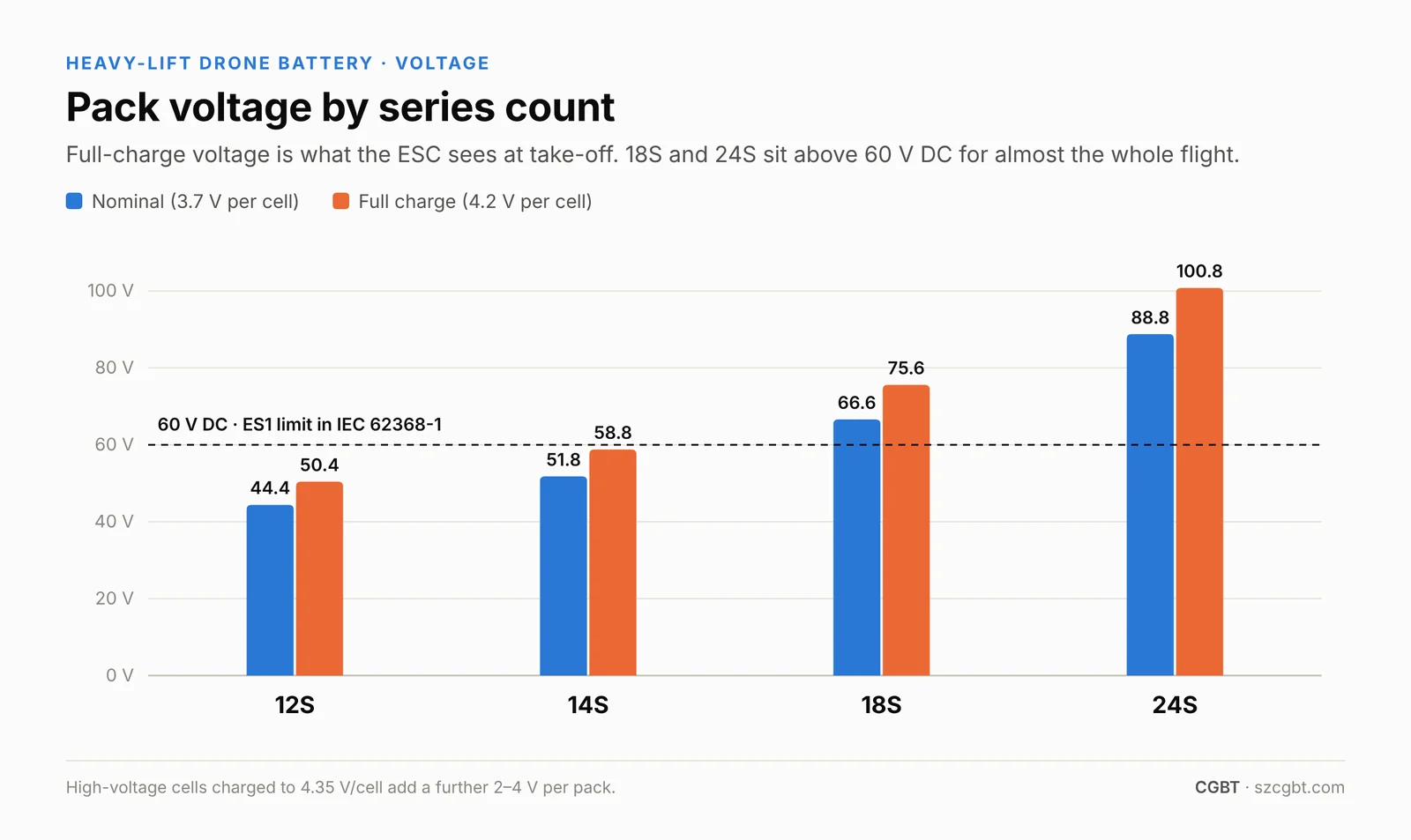
| Series count | Nominal voltage | Full charge at 4.2 V/cell | Full charge at 4.35 V/cell | Where you typically see it |
|---|---|---|---|---|
| 12S | 44.4 V | 50.4 V | 52.2 V | Mid-size cargo and multi-role multirotors |
| 14S | 51.8 V | 58.8 V | 60.9 V | Agricultural sprayers and many delivery drones |
| 18S | 66.6 V | 75.6 V | 78.3 V | Large cargo multirotors and high-thrust propulsion sets |
| 24S | 88.8 V | 100.8 V | 104.4 V | Coaxial heavy-lift octocopters and the largest cargo platforms |
Check the cell chemistry before you compare. Some high-energy semi-solid-state cells use a lower nominal voltage and a higher charge cut-off. Our SLD4-14S150Ah, for example, is rated 49.0 V nominal with a 60.2 V charge cut-off, and our SLD4-24S120Ah is rated 84.0 V nominal with a 103.2 V charge cut-off. Always size against the datasheet of the actual pack.
Two numbers in that table matter more than the nominal figure. The full-charge voltage is what your ESCs see at take-off, so it has to sit inside the ESC’s maximum input rating with margin. The minimum voltage under load is what your motors see at the end of the flight, when they still need enough rpm to hold a fully loaded hover.
Why heavy-lift drones move to higher voltage
Electrical power is voltage multiplied by current (P = V × I). A heavy-lift drone needs a certain amount of power to hold its weight in the air, and that requirement does not change with the battery. What the series count changes is how the power is delivered: higher voltage means lower current.
Take a 10 kW load as an example. It draws about 225 A from a 12S pack, 193 A from 14S, 150 A from 18S and 113 A from 24S.
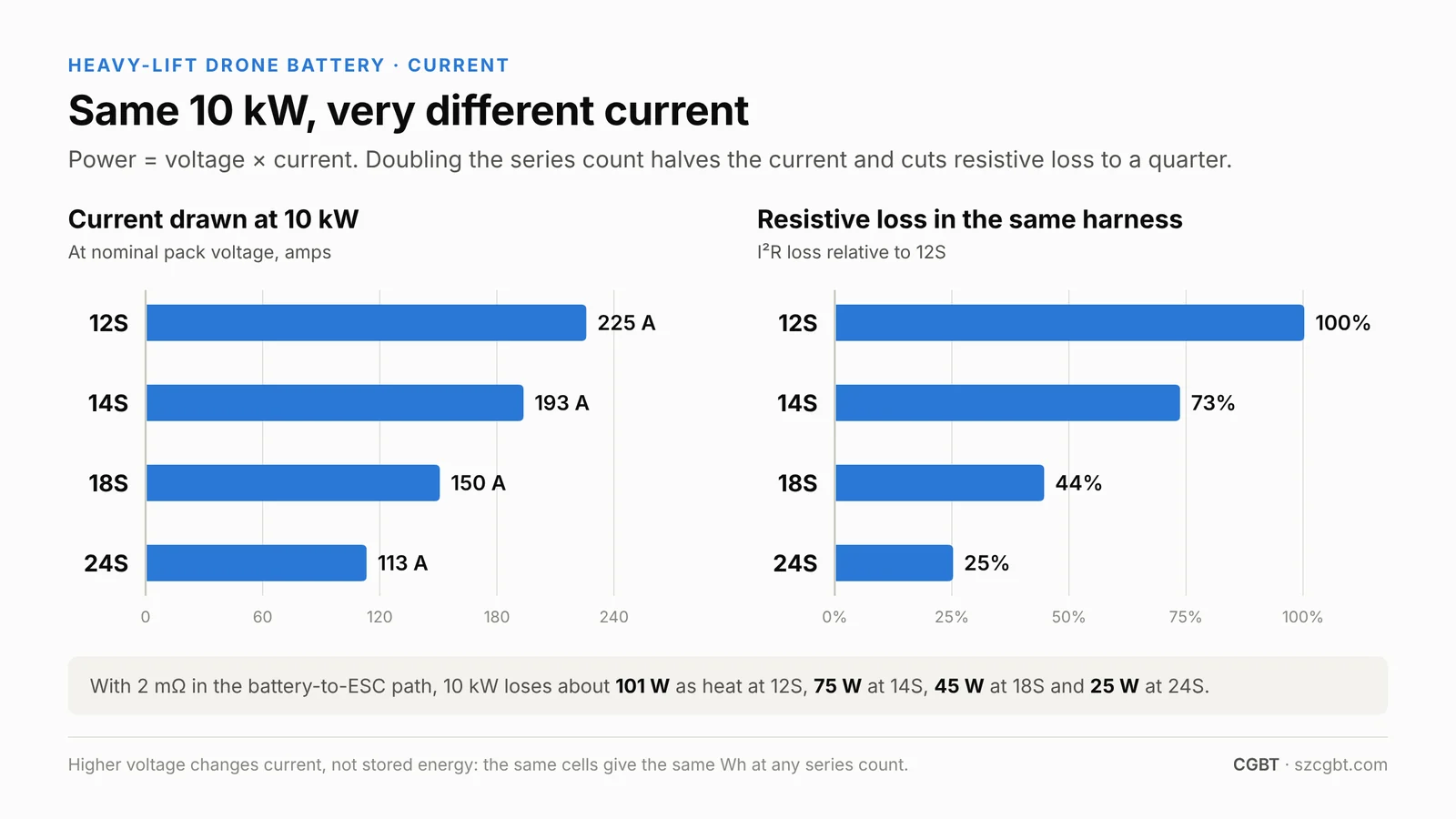
Current is what produces heat. Resistive loss in every cable, connector, solder joint and MOSFET grows with the square of current (Ploss = I²R), so halving the current cuts those losses to a quarter. With just 2 mΩ of total resistance in the battery-to-ESC path, the 10 kW example wastes about 100 W as heat at 12S but only about 25 W at 24S. On a heavy-lift airframe that shows up in three places:
- Lighter wiring. For the same allowable loss, copper cross-section can shrink as current falls. On large frames with long arms, harness weight comes straight out of payload.
- Cooler ESCs and motors. Lower current means less heat in the switching stage and the windings, which matters on long hovers and hot-weather sling-load work.
- More power per connector. A high-current connector of the AS150 class, typically rated around 150 A continuous, can feed about 6.7 kW at 12S nominal voltage but about 13.3 kW at 24S. See our UAV battery connector guide for ratings and derating.
Keep this in proportion, though: higher voltage does not give you more energy. Energy is stored in the cells. A pack built from 48 identical cells holds the same watt-hours whether they are wired 12S4P or 24S2P, and it weighs about the same. Voltage changes the current you have to manage, not the flight time you can buy.
Start with the propulsion system, not the battery
The most common sizing mistake is choosing a battery first and then looking for motors that fit. In practice the series count is already decided by the propulsion system. The motor’s KV (rpm per volt) is wound for a specific voltage so the propeller reaches its design speed, and the ESC has a hard input-voltage window.
Real propulsion systems show how tightly the two are tied together. Hobbywing sells its XRotor X13 heavy-lift motor in two windings, a 60 KV version for 12–14S (61 V maximum) and a 45 KV version for 18S. Its larger H13MD and H15MD coaxial systems are specified for 24S–28S, and the H15MD is also offered in an 18S version. On the commercial side, DJI’s FlyCart 30 delivery drone carries up to two 52.22 V packs, a 14S-class system.
Before you look at any battery, answer four questions:
- What is the ESC’s rated input range and its absolute maximum? This narrows the choice to one or two series counts.
- Which series count was the motor winding chosen for? A different voltage changes propeller speed, thrust and efficiency.
- Does a fully charged pack stay below the ESC maximum with margin? A 14S pack charged to 4.35 V per cell reaches 60.9 V, which is right at the limit of an ESC rated to 61 V and leaves almost no room for transients.
- Does the pack’s voltage under load at the end of the flight still give enough rpm to hover at maximum take-off weight? This is where voltage sag and cold weather bite.
If you are designing a new airframe and do have a free choice, the comparison below shows what each voltage class gives you.
12S vs 14S vs 18S vs 24S: side-by-side comparison
| 12S | 14S | 18S | 24S | |
|---|---|---|---|---|
| Nominal / full-charge voltage (4.2 V/cell) | 44.4 / 50.4 V | 51.8 / 58.8 V | 66.6 / 75.6 V | 88.8 / 100.8 V |
| Current at 10 kW | ≈225 A | ≈193 A | ≈150 A | ≈113 A |
| Resistive loss, same harness (12S = 100%) | 100% | 73% | 44% | 25% |
| Power through one 150 A path | ≈6.7 kW | ≈7.8 kW | ≈10.0 kW | ≈13.3 kW |
| Above 60 V DC at full charge? | No | No at 4.2 V/cell; just over with high-voltage cells | Yes | Yes |
| Charger choice | Widest | Very wide | Moderate | Specialized |
| Typical role | Mid-size cargo, multi-role | Spraying and delivery workhorse | Large cargo, high-thrust motors | Coaxial heavy-lift, largest airframes |
12S drone battery: the flexible starting point
12S (44.4 V nominal) has the deepest ecosystem of motors, ESCs, chargers and connectors, and its packs are the easiest to transport and handle. It is a sensible choice for mid-size cargo and multi-role drones whose total current stays comfortably within one high-current connector and harness. Its limit shows up as power grows: beyond roughly 6–7 kW of continuous draw, a 12S system is pushing well over 150 A, and wiring, connectors and ESC cooling start to dominate the design.
Example pack: SLD4-12S-81Ah (3.6 kWh, 9.3 kg), with smaller 12S packs from 25 Ah in our 400 Wh/kg series.
14S drone battery: the workhorse for spraying and delivery
14S (51.8 V nominal, 58.8 V at 4.2 V per cell) is popular for a practical reason. At standard charge voltage it stays just below 60 V DC, the voltage limit that electrical safety standards such as IEC 62368-1 use for their lowest energy-source class (ES1). That keeps handling, connectors and charger design simpler, while still cutting current by about 14% compared with 12S. It is widely used on agricultural spraying drones and on delivery platforms. Note that cells charged to 4.3–4.35 V push a 14S pack just over 60 V.
Example packs: SLD4-14S-72Ah (3.7 kWh, 9.5 kg) and the high-capacity SLD4-14S150Ah (7.35 kWh, about 19 kg, 300 A continuous).
18S drone battery: the step up for large cargo frames
18S (66.6 V nominal, 75.6 V at full charge) draws a third less current than 12S for the same power and cuts resistive loss by more than half. It suits large cargo multirotors whose power demand has outgrown a 14S harness, and it is the native voltage of several high-thrust propulsion sets. The trade-off is that the pack now sits above 60 V DC for almost the whole discharge, so connectors, insulation, chargers and ground procedures have to be specified for higher voltage.
Example pack: SLD3-18S-81Ah (5.4 kWh, 16 kg).
24S drone battery: for the biggest airframes
A 24S drone battery (88.8 V nominal, 100.8 V at 4.2 V per cell) halves current compared with 12S and cuts resistive loss to a quarter. That is why the largest coaxial heavy-lift propulsion systems are built around it. Hobbywing’s H13MD, for example, is specified for 24S–28S and recommends a pair of 24S 70 Ah packs for a recommended take-off weight of 180 kg on a four-axis, eight-propeller frame. If your airframe needs well over 10 kW for long periods, 24S is usually the cleanest way to keep current, cable weight and heat under control.
The costs are real, though. Fewer chargers support 24S, anti-spark connectors or a pre-charge circuit become essential to avoid arcing when large ESC capacitors are connected, and crews need training to handle packs that reach about 100 V DC at full charge. A 24S pack also strings many cells in series, so cell matching and balancing quality matter more: one weak cell limits the whole string.
Example pack: SLD4-24S120Ah (84.0 V nominal, 10.08 kWh, about 26 kg, 240 A continuous), the largest-energy pack in our standard heavy-lift range.
How to size capacity: start from watt-hours
Once the voltage is fixed, capacity follows from an energy budget. Work in watt-hours first, because watt-hours are what keep the drone in the air; amp-hours only mean something at a given voltage.
- Estimate average power over the mission. Use the propulsion supplier’s thrust tables at your take-off weight or, better, logged power from test flights. Include climb, cruise, hover over the drop zone and any winch or sling-load hold.
- Multiply by the flight time you need, including your landing reserve.
- Divide by the usable fraction of the pack. Plan on using no more than about 80% of rated energy to protect cycle life and keep voltage margin at the end of the flight. Derate further for cold weather; see our guide to drone batteries in cold weather.
- Convert to amp-hours by dividing by the pack’s nominal voltage.
Required energy (Wh) = average power (W) × flight time (h) ÷ usable fraction
Required capacity (Ah) = required energy (Wh) ÷ nominal pack voltage (V)
Worked example. An airframe that averages 8 kW and needs 30 minutes, using 80% of rated energy, needs 8,000 × 0.5 ÷ 0.8 = 5,000 Wh. That is about 113 Ah at 12S, 97 Ah at 14S, 75 Ah at 18S or 56 Ah at 24S. The energy is the same in every case, but the amp-hour figures are very different, which is why comparing packs by Ah alone across different voltages is misleading.
Check the discharge rating (C-rate) and voltage sag
C-rate expresses current relative to capacity: 1C on a 100 Ah pack is 100 A. A heavy-lift battery has to meet two ratings:
- Continuous rating against average and hover current. Long hovers, sling-load holds and climbs at maximum weight need that current for minutes at a time without the pack overheating.
- Peak rating against take-off and gust bursts. Lift-off at full payload and hard corrections can draw a multiple of the average for a few seconds. Check how long the peak is rated for and under what conditions. Our SLD4-14S150Ah, for example, is rated 300 A continuous and 450 A for 10 seconds above 50% state of charge.
The check itself is simple: the continuous C-rate you need equals average current divided by capacity. Here is the 8 kW, 30-minute mission from above, built four ways from our standard packs:
| Series | Example configuration | Energy | Current at 8 kW | C-rate needed | Rated continuous | Listed mass |
|---|---|---|---|---|---|---|
| 12S | 2 × SLD4-12S-81Ah in parallel (162 Ah) | 7.19 kWh | ≈180 A | 1.1C | 2C | 18.6 kg |
| 14S | SLD4-14S150Ah (49.0 V) | 7.35 kWh | ≈163 A | 1.1C | 2C (300 A) | ≈19 kg |
| 18S | SLD3-18S-81Ah | 5.40 kWh | ≈120 A | 1.5C | 3C | 16 kg |
| 24S | SLD4-24S120Ah (84.0 V) | 10.08 kWh | ≈95 A | 0.8C | 2C (240 A) | ≈26 kg |
A few things stand out. Every option covers the 5,000 Wh budget, the 18S pack with the smallest margin and the 24S pack with far more energy than this mission needs; a real 24S design would specify a smaller custom capacity and run the same C-rate check on it. The mass differences come from capacity and cell grade (the 18S pack uses 350 Wh/kg SLD3 cells, the others 400 Wh/kg SLD4 cells), not from voltage. And paralleling two packs, as in the 12S option, needs matched capacity and state of charge plus a power path and BMS designed for it.
Voltage sag deserves its own margin. Under load, pack voltage drops by current multiplied by internal resistance. A pack running near its continuous limit sags more and heats faster, and the sag is worst late in the flight, at low state of charge and in the cold, exactly when the drone may need full power to land. As a rule of thumb, a pack that runs well below its continuous rating in normal flight holds voltage better and lasts more cycles than one running at the limit.
Weight, energy density and the payload trade-off
On a heavy-lift drone, every kilogram of battery is a kilogram that cannot be payload, so energy density (Wh/kg) decides how much flight time each kilogram buys. Our semi-solid-state cells reach 350–400 Wh/kg, 20–50% higher than conventional LiPo, and that energy can be spent on payload, range or reserve. When you compare suppliers, look at pack-level figures, not only cell-level ones; our article on cell vs pack energy density explains the gap, and semi-solid vs solid-state vs LiPo compares the chemistries.
Because voltage does not change energy per kilogram, choose the series count on electrical grounds first, then pick the cell grade on mass and cost: SLD4 at 400 Wh/kg for maximum range, or SLD3 at 350 Wh/kg for a balance of cost and density.
Don’t forget the rest of the system
- BMS and data. A heavy-lift pack needs protection, cell balancing and state-of-charge reporting, with a communication protocol that matches your flight controller. More cells in series means more balance channels to monitor.
- Single or dual packs. Two matched packs add redundancy and make a battery load of 20 kg or more easier to lift into the airframe. Both packs must have matched capacity and be managed together.
- Connectors and wiring. Size connectors and wire gauge to peak current, not average. On high-voltage packs, use anti-spark connectors such as XT90S or AS150S, or a pre-charge circuit, to stop arcing when the ESC capacitors charge.
- Charging. The charger must support the cell count and deliver enough power for your turnaround time. A 10 kWh pack on a 3 kW charger needs more than three hours, so for large fleets charger power can become the bottleneck. Our UAV chargers cover 6S–14S, 12S–14S and 14S–18S at up to 6 kW, and 14S–24S with the EV-PEAK UD2 Pro.
- Shipping. Packs of this size travel as dangerous goods and need UN38.3 test documentation. Ask your supplier how they ship; we deliver worldwide, including DDP.
Quick selection checklist
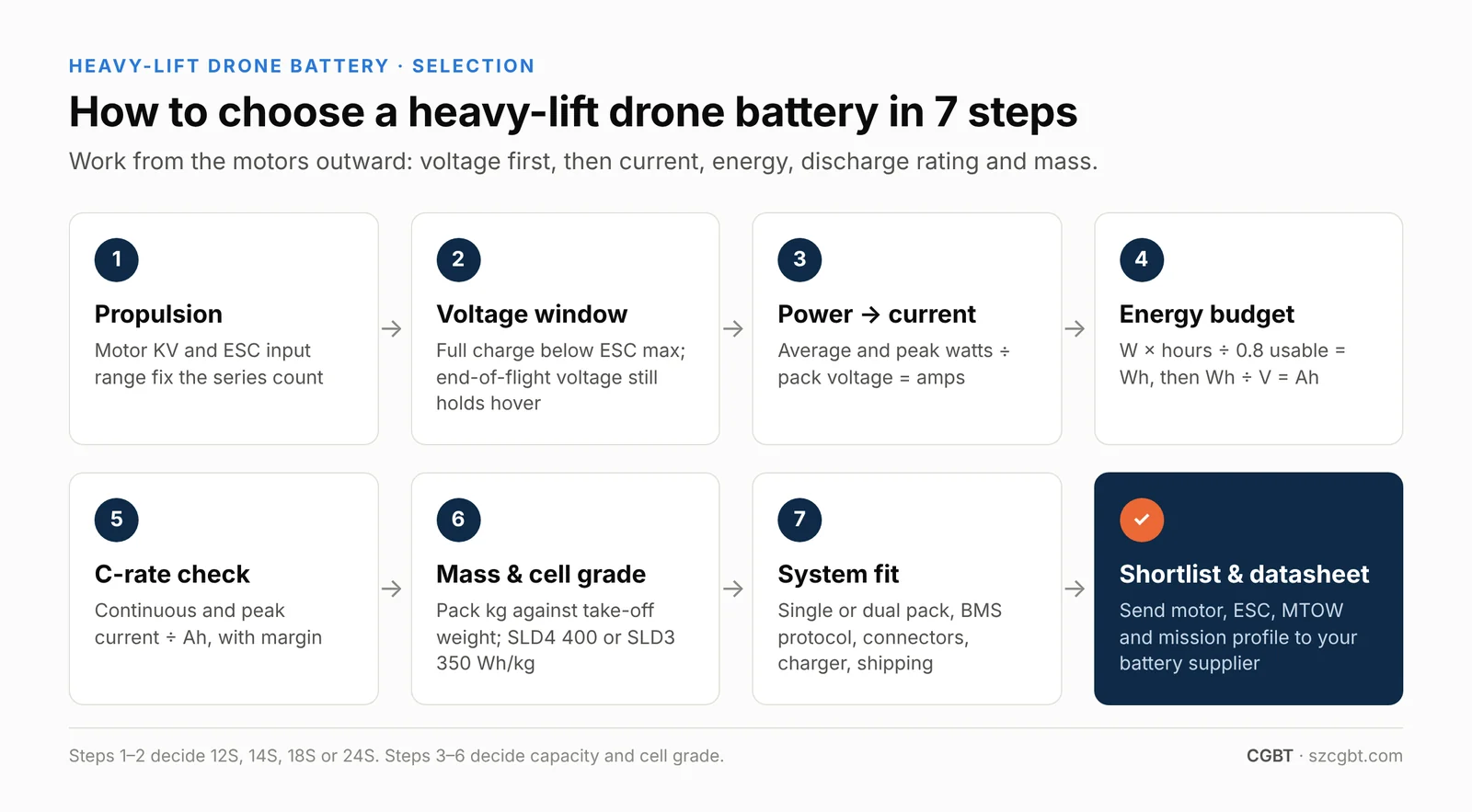
- Confirm the ESC input range and motor KV, and pick the series count they were designed for.
- Check that full-charge voltage stays below the ESC maximum with margin, and that end-of-flight voltage under load still holds hover.
- Estimate average and peak power, then convert to current at your voltage.
- Build the energy budget in Wh and convert it to Ah.
- Check the continuous and peak C-ratings with margin.
- Check total pack mass against your take-off weight and choose the cell grade.
- Agree on single or dual packs, BMS protocol, connectors, chargers and shipping.
CGBT heavy-lift batteries at a glance
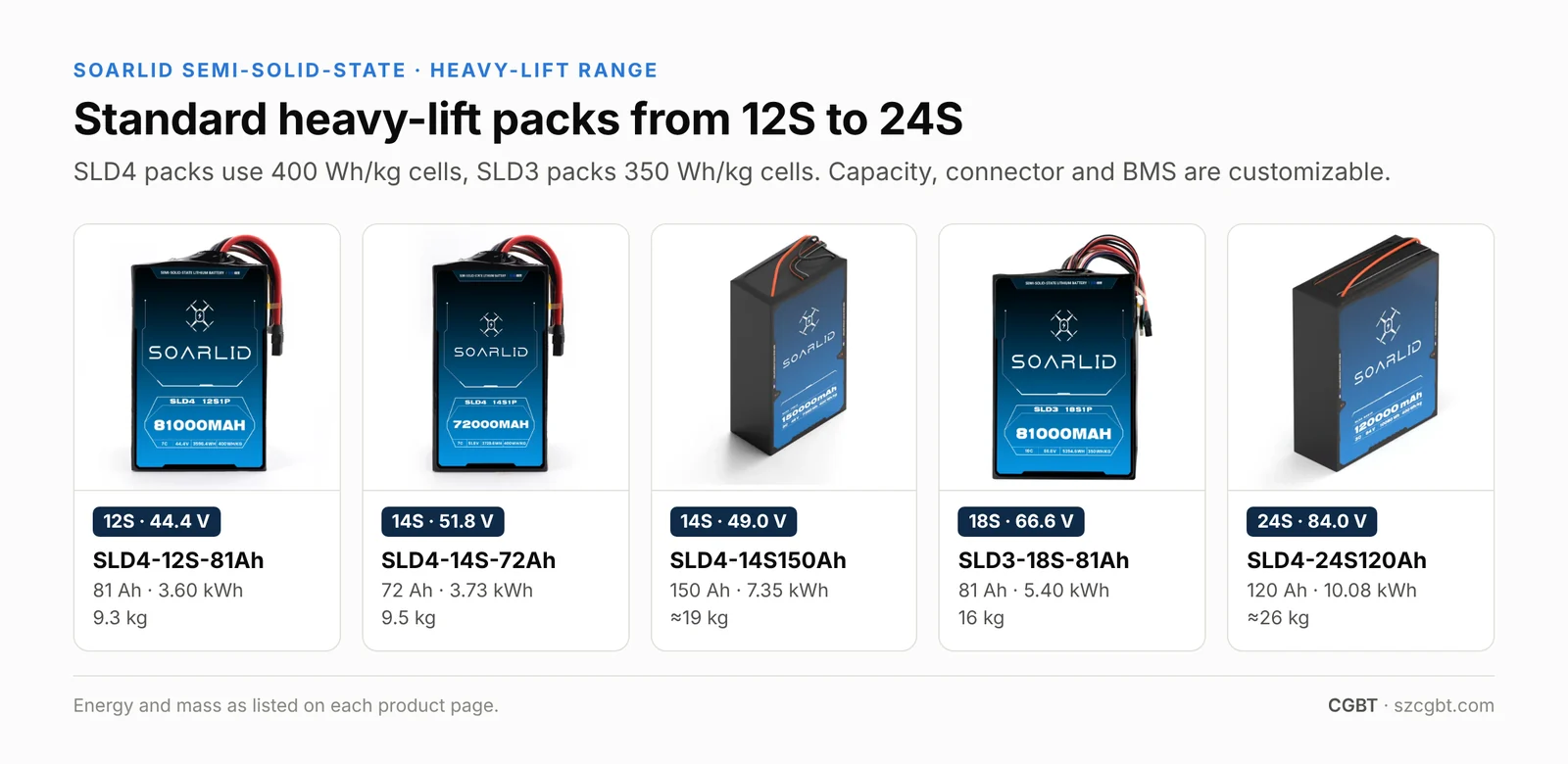
| Model | Series / nominal voltage | Capacity | Energy | Mass | Cell energy density |
|---|---|---|---|---|---|
| SLD4-12S-81Ah | 12S / 44.4 V | 81 Ah | 3,596 Wh | 9.3 kg | 400 Wh/kg |
| SLD4-14S-72Ah | 14S / 51.8 V | 72 Ah | 3,730 Wh | 9.5 kg | 400 Wh/kg |
| SLD4-14S150Ah | 14S / 49.0 V | 150 Ah | 7,350 Wh | ≈19 kg | 400 Wh/kg |
| SLD3-18S-81Ah | 18S / 66.6 V | 81 Ah | 5,395 Wh | 16 kg | 350 Wh/kg |
| SLD4-24S120Ah | 24S / 84.0 V | 120 Ah | 10,080 Wh | ≈26 kg | 400 Wh/kg |
Other series counts, capacities, connectors and BMS protocols are available as custom builds, including split-pack designs for the largest airframes. Browse the full heavy-lift and delivery battery range, or send us your motor and ESC model, take-off weight and mission profile. Our engineers will recommend a series count and capacity and send you the datasheet.
Frequently asked questions
Is a 24S battery better than 14S for a heavy-lift drone?
Not automatically. For the same power, 24S draws about 42% less current than 14S, which means lighter wiring and cooler ESCs, so it is the better choice for very high-power airframes. But it only works if the motors and ESCs are designed for 24S, and 14S remains simpler to charge, ship and handle. Choose the voltage your propulsion system was built for.
Can I use a 14S battery on a 12S drone?
Only if the ESCs and motors are explicitly rated for 14S. A full 14S pack reaches 58.8 V, or more with high-voltage cells, which can destroy an ESC designed for 12S, and the motors will spin faster than the propellers and airframe were designed for.
How many amp-hours does a heavy-lift drone battery need?
Work out energy first: average power × flight time ÷ usable fraction (about 0.8). Then divide by pack voltage. An 8 kW, 30-minute mission needs about 5,000 Wh, which is about 97 Ah at 14S or 56 Ah at 24S.
What is the largest heavy-lift drone battery CGBT makes?
Our standard range goes up to 150 Ah at 14S and 120 Ah at 24S. The SLD4-24S120Ah stores about 10 kWh. Larger capacities and split-pack designs are available as custom projects.
Are high-voltage drone batteries safe to handle?
Yes, when the system is designed for it. Above about 60 V DC, use anti-spark connectors or pre-charge, insulated tools, proper enclosures and trained crews, together with a BMS that provides over-voltage, under-voltage, over-current and temperature protection.