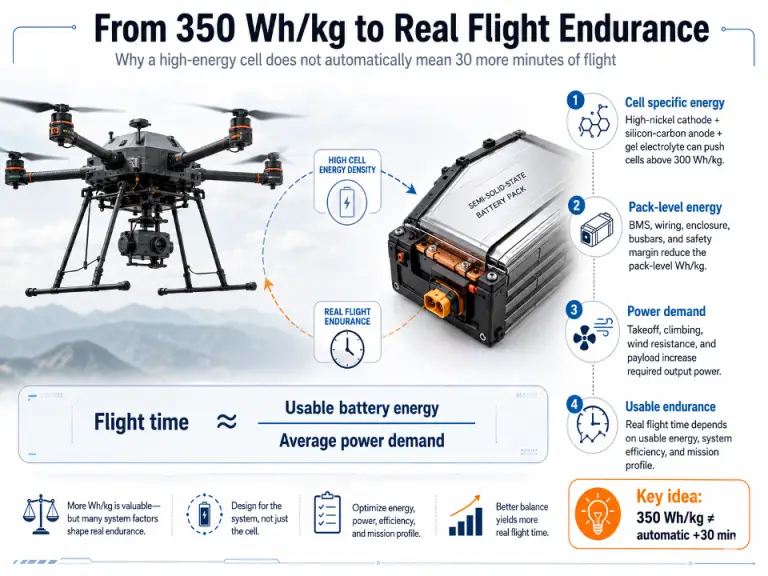

A 460 Wh/kg rating describes a single cell. A drone carries a finished pack, lands with a reserve and loses energy to heat, cold and age. This guide shows how to turn the datasheet number into minutes in the air, using CGBT’s own 450–460 Wh/kg semi-solid-state pack data and a simple hover model you can reuse.
1. Two numbers that are easy to confuse
Energy density (strictly, specific energy) is stored energy divided by mass. The question that matters is: the mass of what?
- Cell energy density counts one cell: electrodes, electrolyte, separator, pouch film and tabs. It describes the chemistry and the cell design, and it is the number most suppliers quote first. It is the “460” in 460 Wh/kg.
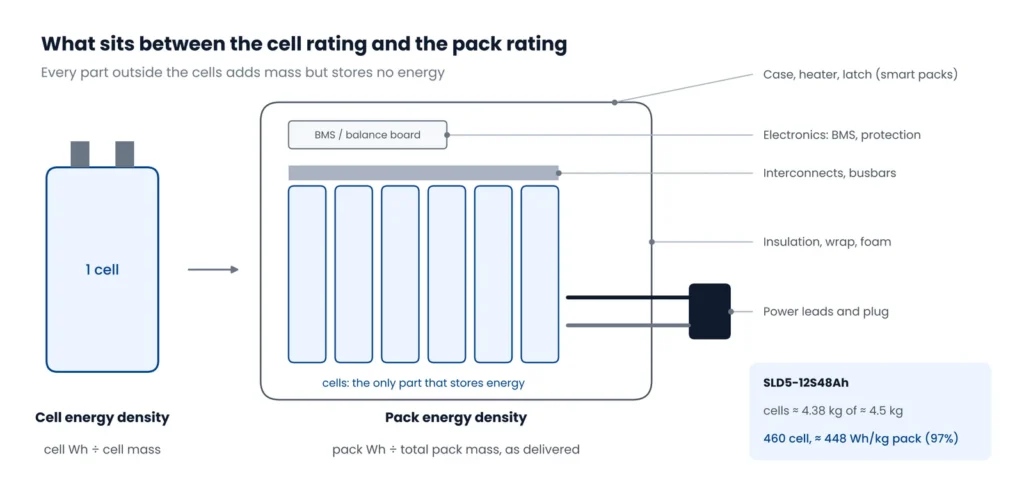
- Pack energy density counts everything the aircraft carries: the cells plus interconnects, power leads, connectors, balance harness, insulation, wrapping or case, and any electronics such as a BMS or protection board or a self-heating film.
| Quantity | How it is calculated |
|---|---|
| Cell energy density | cell nominal voltage × cell capacity ÷ cell mass |
| Pack energy density | pack nominal energy ÷ total pack mass, as delivered |
| Cell-to-pack ratio | pack energy density ÷ cell energy density |
Your airframe only ever sees the pack number. It is always lower than the cell figure, and the size of the gap depends on how the pack is built.
2. What 460 Wh/kg becomes in a real pack
Here is the calculation for the SLD5-12S48Ah, the highest energy density pack in the CGBT range:
- Cell: CGB10588187, 3.5 V nominal × 48 Ah = 168 Wh. At 460 Wh/kg that is about 365 g per cell.
- Twelve cells in series: about 4.38 kg of cells storing 2,016 Wh.
- Finished pack: approximately 4.5 kg, including 8 AWG power leads, an XT90 plug and the balance lead.
- Pack energy density: 2,016 Wh ÷ 4.5 kg ≈ 448 Wh/kg, a cell-to-pack ratio of about 97%.
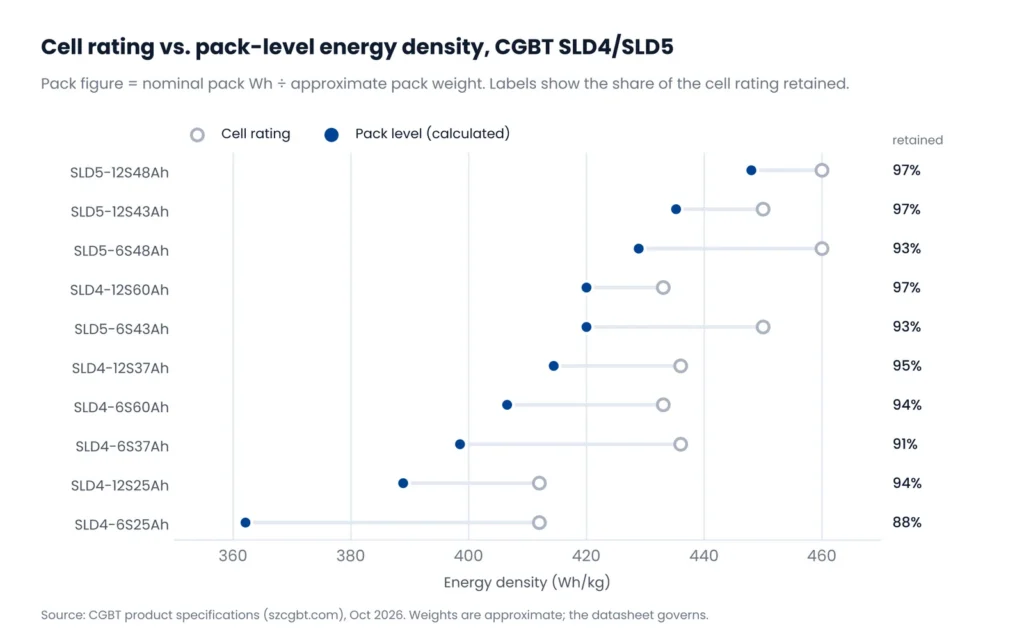
Applying the same arithmetic to the rest of the SLD5 and SLD4 lines gives the spread below.
| Model | Cell rating | Pack energy | Approx. weight | Pack level | Retained |
|---|---|---|---|---|---|
| SLD5-12S48Ah | 460 Wh/kg | 2,016 Wh | 4.50 kg | 448 Wh/kg | 97% |
| SLD5-6S48Ah | 460 Wh/kg | 1,008 Wh | 2.35 kg | 429 Wh/kg | 93% |
| SLD5-12S43Ah | 450 Wh/kg | 1,806 Wh | 4.15 kg | 435 Wh/kg | 97% |
| SLD5-6S43Ah | 450 Wh/kg | 903 Wh | 2.15 kg | 420 Wh/kg | 93% |
| SLD4-12S60Ah | 433 Wh/kg | 2,520 Wh | 6.00 kg | 420 Wh/kg | 97% |
| SLD4-6S60Ah | 433 Wh/kg | 1,260 Wh | 3.10 kg | 406 Wh/kg | 94% |
| SLD4-12S37Ah | 436 Wh/kg | 1,554 Wh | 3.75 kg | 414 Wh/kg | 95% |
| SLD4-6S37Ah | 436 Wh/kg | 777 Wh | 1.95 kg | 398 Wh/kg | 91% |
| SLD4-12S25Ah | 412 Wh/kg | 1,050 Wh | 2.70 kg | 389 Wh/kg | 94% |
| SLD4-6S25Ah | 412 Wh/kg | 525 Wh | 1.45 kg | 362 Wh/kg | 88% |
Two patterns stand out. At the same capacity, 12S packs keep more of the cell rating than 6S packs: the SLD5-6S48Ah keeps about 93% against 97% for its 12S sibling. And the lowest figure in the range belongs to the smallest pack, the SLD4-6S25Ah, at about 88%. The non-cell parts weigh roughly the same in every pack, around 120 to 190 g across this range, so they take a bigger bite out of a small pack than a large one.
These are soft packs. A smart pack with a rigid housing, a communicating BMS, a self-heating layer or a quick-release latch carries more non-cell mass, so its pack figure sits further below the cell rating. That is not a reason to avoid smart packs. It is a reason to ask for the pack weight, as delivered, before you compare suppliers.
3. From pack energy to energy you can plan with
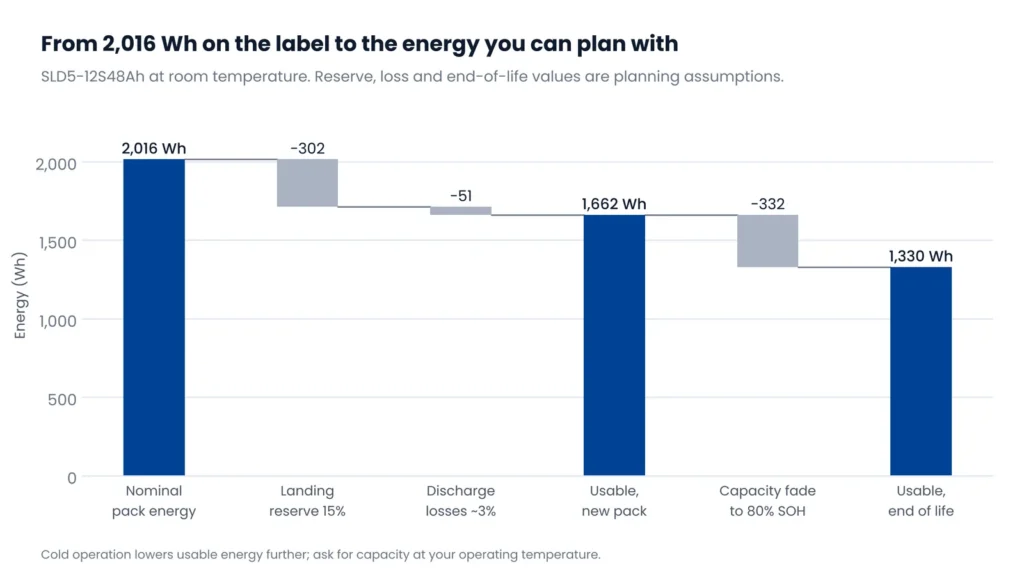
Nominal energy is measured under gentle laboratory conditions. IEC 61960-3, the performance standard for portable secondary lithium cells, establishes rated capacity by a controlled discharge at 20 °C, with separate checks at 0 °C and −20 °C [3]. A drone in the field flies outside those conditions, so plan with what remains after four deductions:
- Landing reserve. Operators land with energy left for a go-around or a headwind on the way home. We use 15%.
- Discharge losses. Current through the battery’s internal resistance turns part of the energy into heat, and voltage sag can trigger the low-voltage cut-off early. Losses grow with current. We assume 3% at hover current; replace this with discharge-curve data at your own mission current.
- Temperature. Usable capacity falls in the cold. In IEC 61960-3 testing, typical pass thresholds at −20 °C are only 50 to 60% of nominal capacity [3]. SLD5 packs are rated for discharge down to −20 °C and the SLD4 60 Ah packs down to −40 °C, but always ask for measured capacity at your operating temperature.
- Ageing. Capacity fades with use. If the mission must still be possible late in the pack’s service life, plan with end-of-life capacity. We use 80% state of health (SOH) as an example.
4. How energy density turns into flight time
For a multirotor in hover, momentum theory gives the ideal power needed to produce thrust T with total rotor disc area A in air of density ρ as T1.5 ÷ √(2ρA) [2]. Real rotors, motors and ESCs are less efficient, so a practical estimate is:
| Quantity | Estimate |
|---|---|
| Hover power | (m × g)1.5 ÷ (√(2ρA) × η) + avionics and payload power |
| Hover time | usable energy ÷ hover power |
Because power rises with mass to the power 1.5, battery mass works against you. Two consequences follow:
- If the battery budget is fixed by mass, hover time rises in direct proportion to pack energy density. A pack that is 10% denser at pack level gives about 10% more time.
- If you keep the same energy and take the weight saving instead, the aircraft gets lighter, hover power falls faster than mass, and you gain time or payload on top.
Worked example
The reference aircraft is a generic quadcopter of the kind used for inspection and mapping. The assumptions are below.
| Parameter | Value |
|---|---|
| Mass without battery (airframe + payload) | 10.0 kg |
| Rotors | 4 × 30-inch, total disc area 1.82 m² |
| Combined rotor and drive efficiency η | 0.55 |
| Avionics and payload power | 50 W |
| Air density | 1.225 kg/m³ (sea level, 15 °C) |
| Battery budget | 4.5 kg |
| Reserve / discharge losses | 15% / 3% |
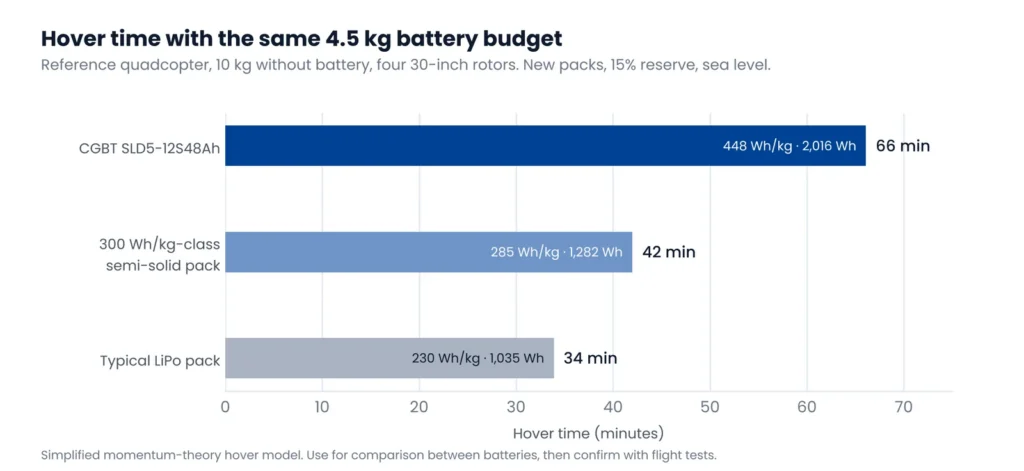
At 14.5 kg take-off mass, the model gives a hover power of about 1.51 kW. On the 42 V SLD5-12S48Ah that is about 36 A, or 0.75C. Here is how three batteries compare in the same 4.5 kg budget:
| Battery | Pack level | Energy in 4.5 kg | Hover time |
|---|---|---|---|
| Typical LiPo pack (assumed) | 230 Wh/kg | 1,035 Wh | ≈34 min |
| 300 Wh/kg-class semi-solid cell, 95% retained (assumed) | 285 Wh/kg | 1,282 Wh | ≈42 min |
| CGBT SLD5-12S48Ah | 448 Wh/kg | 2,016 Wh | ≈66 min |
The LiPo baseline reflects the roughly 200 Wh/kg class of batteries in many current drones [4], and the 300 Wh/kg class matches commercially available semi-solid-state cells, which are commonly quoted at 280 to 350 Wh/kg [5].
The second option is to keep the LiPo’s 1,035 Wh and take the weight saving. At 448 Wh/kg that energy weighs 2.31 kg instead of 4.5 kg. Fly the lighter 12.3 kg aircraft and hover power drops to about 1.19 kW, for about 43 minutes: 27% more than the LiPo from the same energy. Or put the 2.19 kg saving into payload and keep the original 34 minutes, which is the trade-off heavy-lift and delivery drones care about most.
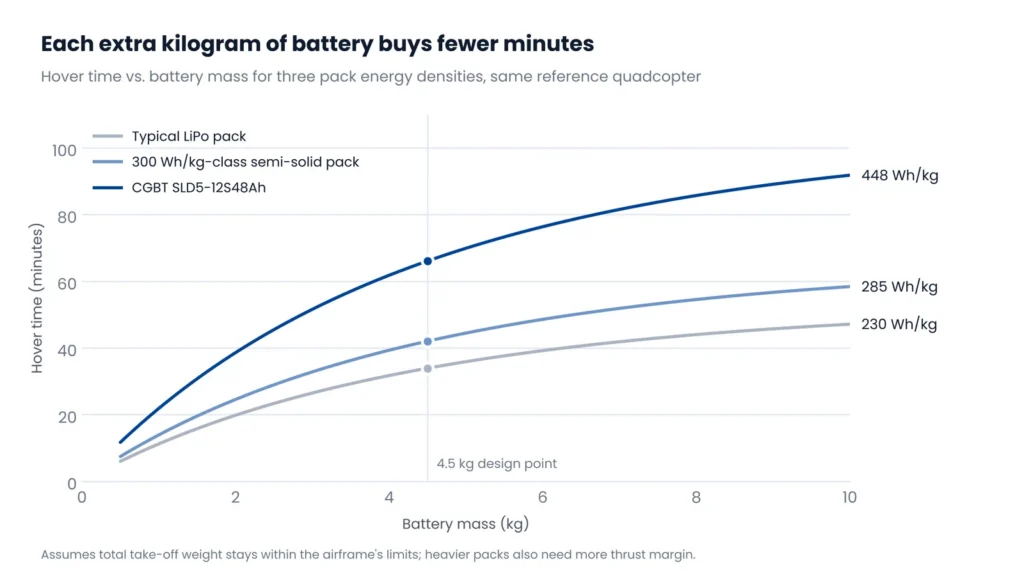
The model is deliberately simple. Forward flight, wind, climbs, motor efficiency at different throttle settings and altitude all change the absolute numbers. Use it to compare batteries on equal terms, then confirm with flight tests on your own airframe. With the end-of-life energy from Figure 3, the same SLD5 pack still gives about 53 minutes at 80% state of health.
5. Energy is not power: check the C-rate
Cells optimised for energy density usually accept less current. The SLD5 series is rated 1C continuous and 3C peak for 10 seconds above 50% state of charge. Our example hovers at about 0.75C, which fits, but leaves limited headroom for long climbs, sustained high wind or aggressive manoeuvres.
A quick check: divide your highest sustained power by the pack’s nominal voltage to get current, then divide by capacity in Ah. That is the C-rate the pack must deliver continuously, and it should sit comfortably below the rating. If it does not, a pack from the SLD4 series at 1.5C continuous and 5C peak may fly longer in practice, even with a lower cell rating, because it stays out of current limiting. Spraying drones, which take off near maximum weight on every sortie, normally need dedicated high-rate smart packs.
Cycle life is the other trade-off to read alongside Wh/kg. The SLD5 packs are rated for 300 cycles. Ask how any supplier defines cycle life, to what remaining capacity and at what charge and discharge rates, before comparing figures.
6. Seven questions to ask about any Wh/kg claim
- Is the figure cell-level or pack-level? If it is a cell figure, what does the finished pack weigh with leads and connectors?
- At what discharge rate, temperature and cut-off voltage was capacity measured, and is it typical or minimum capacity?
- Which nominal voltage was used to calculate watt-hours?
- What are the continuous and peak C-ratings, for how long, and at what state of charge?
- What capacity does the pack deliver at your lowest operating temperature?
- How is cycle life defined, and what capacity remains at end of life?
- Can the supplier share discharge curves or flight logs from a comparable aircraft?
Bottom line
460 Wh/kg is a real and useful number, but it is the start of the calculation, not the answer. Convert it to pack level, subtract what you cannot use, and run it through a power model of your aircraft. Done that way, the SLD5-12S48Ah keeps about 97% of its cell rating at pack level and, in our reference quadcopter, roughly doubles hover time against a typical LiPo pack of the same mass.
Want this calculation for your own airframe? Send CGBT your take-off weight, rotor size, payload, operating temperature and mission profile, and our engineers will size a custom semi-solid-state pack and estimate flight time with real pack data. Request a quote.
Frequently asked questions
Is 460 Wh/kg a cell or a pack figure?
For CGBT’s SLD5 series it is the cell rating. The SLD5-12S48Ah works out to about 448 Wh/kg at pack level, based on its nominal 2,016 Wh and approximate 4.5 kg weight.
How much longer will my drone fly with a 460 Wh/kg battery?
At equal battery mass, hover time scales roughly with pack-level energy density. Against a 230 Wh/kg LiPo pack, a 448 Wh/kg pack nearly doubles hover time in our reference example. Your result depends on airframe, conditions and reserve policy.
Why do small battery packs have lower pack-level energy density?
Leads, connectors, wrapping and boards weigh about the same regardless of pack size, so they are a larger share of a small pack’s mass.
Is a 460 Wh/kg pack right for an agricultural spraying drone?
Usually not. Spraying needs high current at every take-off. The SLD5 series is tuned for endurance at 1C continuous; spraying platforms are better served by high-rate smart packs.
References
- CGBT product specifications, SLD5 and SLD4 semi-solid-state drone batteries, October 2026. szcgbt.com
- Aerodynamics of Rotor Blades for Quadrotors, arXiv:1601.00733. arxiv.org
- Battery Design, Cell capacity testing: standards, diagnostics and safety. batterydesign.net
- Notebookcheck, Solid-state battery for drones and Tesla Optimus-style robots enters mass production, September 2025. notebookcheck.net
- Great Power, Drone Battery Innovations for Longer Flight and Safer Drones by 2026, September 2025. greatpower.net