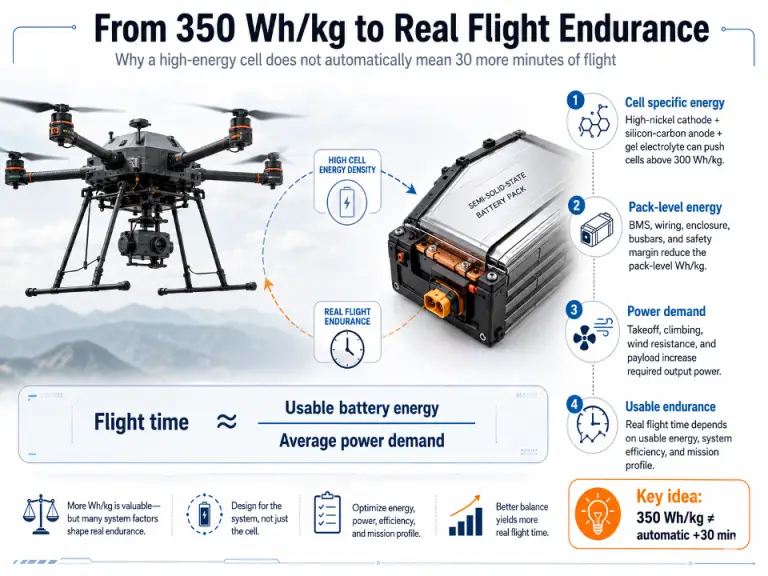
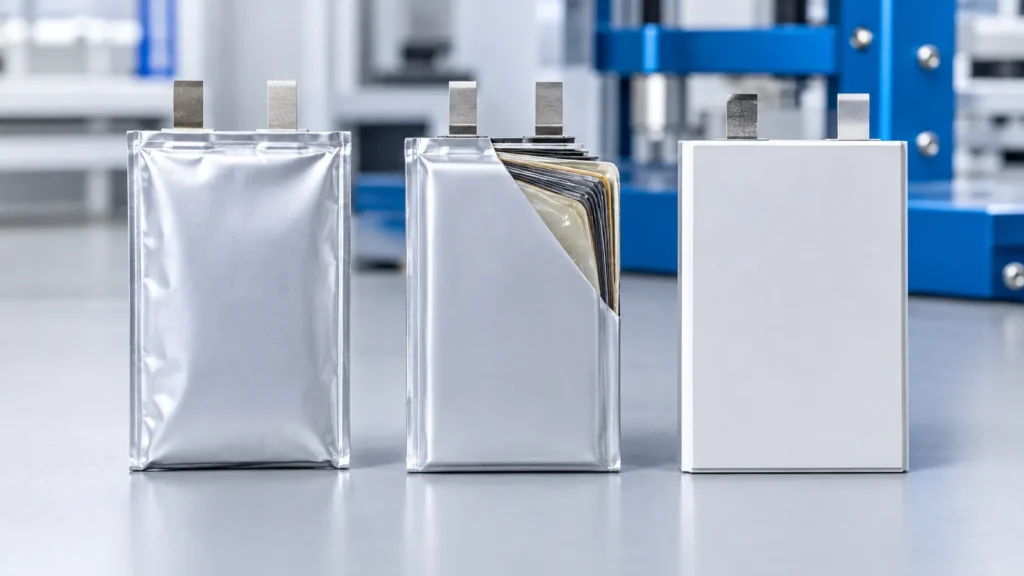
Three battery labels now compete on drone spec sheets, and only one of them means the same thing to every supplier. This guide explains what LiPo, semi-solid and all-solid-state batteries actually are, what you can buy in 2026, and where each one wins. CGBT makes semi-solid-state batteries, so we have been deliberate about showing where LiPo is still the better choice and where all-solid-state is not ready yet.
1. What the three names actually mean
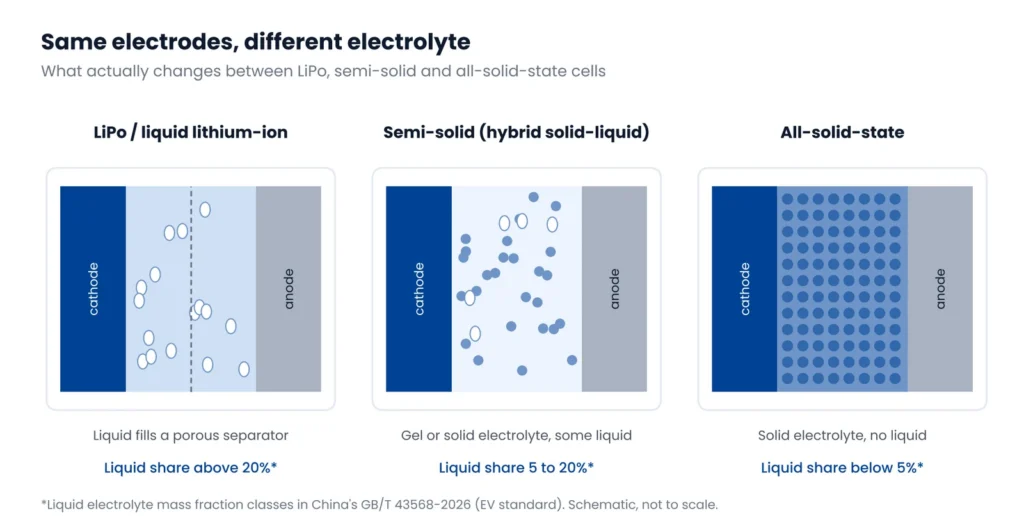
All three are lithium batteries, and their electrodes can be very similar. The real difference is the electrolyte, the material that carries lithium ions between cathode and anode.
- LiPo. In drones, “LiPo” almost always means a lithium-ion pouch cell whose electrolyte is a liquid, sometimes lightly gelled, soaked into a porous separator. It is mature, cheap and very good at delivering high current.
- Semi-solid (also called quasi-solid or hybrid solid-liquid). Much of the liquid is replaced by a gel polymer or solid electrolyte, but a small amount of liquid stays to keep good contact with the electrodes [2]. Mitsui’s 2025 industry report notes there is no formal definition and that cells are generally called semi-solid when liquid electrolyte is 10% or less of battery weight [1].
- All-solid-state. No liquid at all: the electrolyte is a solid such as a sulfide, oxide, polymer or halide. This removes the flammable liquid, but keeping solid-to-solid contact inside the cell is the main engineering challenge [2].
The labels finally have numbers
For years, “solid-state” on a drone battery could mean almost anything; even batteries marketed as solid-state were often quasi-solid [2]. That is starting to change. China’s GB/T 43568-2026, in force since 1 July 2026, sorts cells by liquid electrolyte mass fraction: liquid above 20%, hybrid solid-liquid 5–20%, and all-solid-state below 5%, which must also lose no more than 0.5% of its mass after 6 hours of vacuum drying at 120 °C [3][4]. Loose marketing terms such as “semi-solid” and “quasi-solid” give way to these categories.
The standard is written for electric-vehicle batteries and there is no drone equivalent yet, but it gives buyers a precise question to ask any supplier: which category is your cell, and what is its liquid content? For the record, CGBT’s SLD cells are semi-solid (hybrid solid-liquid) designs. We do not sell all-solid-state cells today.
2. Side by side: the 2026 picture
The table summarises where each technology stands. Figures are typical ranges from suppliers and analysts; individual products vary.
| LiPo / LiHV | Semi-solid (hybrid solid-liquid) | All-solid-state | |
|---|---|---|---|
| Electrolyte | Liquid, sometimes gelled | Gel or solid, plus a small liquid share | Solid only |
| Cell energy density | 150–220 Wh/kg; LiHV 230–290 [5] | About 280–500 Wh/kg quoted [6][7]; CGBT 260–460 [10] | Today: about 300 Wh/kg in first-generation UAV cells [8]. Expected: 350–500 as it matures [1] |
| Continuous discharge | Up to ~100C quoted; LiHV 15–40C [5] | 1–1.5C (high-energy) to 10C (high-rate) [10] | Little public drone data |
| Cycle life | 300–500 [5] | About 300–500+, design-dependent [7][10] | Little public drone data |
| Cold weather | Capacity falls sharply below 0 °C | Many packs rated to −20 °C, some to −40 °C [10] | Claimed better; little drone field data |
| Fire risk | Highest: flammable liquid | Lower, not eliminated [1][2] | Lowest in principle; still being validated |
| Cost per Wh | Lowest | Higher [1] | Highest today, about 2× liquid cells [15] |
| Availability 2026 | Mature, widely stocked | Volume production at several suppliers | Early production and pilots |
| Typical best use | FPV, racing, spraying | Endurance: mapping, inspection, VTOL, delivery | Evaluation programs |
3. Energy density: where semi-solid leads today
Standard LiPo cells sit at about 150–220 Wh/kg and high-voltage LiHV at 230–290 Wh/kg [5]. Commercially available semi-solid cells have commonly been quoted at 280–350 Wh/kg [6], and at least one supplier now advertises UAV cells up to 500 Wh/kg [7]. CGBT’s own range runs from 260 Wh/kg in our high-power packs to 460 Wh/kg in the SLD5 series [10].
All-solid-state needs a note on timing. Its higher ceiling is the main reason the industry is investing in it: analysts expect 350–500 Wh/kg from all-solid-state designs as they mature [1]. Today’s first-generation cells are not there yet. The first all-solid-state cell aimed at UAVs and robots from one of China’s largest battery makers is rated 300 Wh/kg, with a 400 Wh/kg goal and 100 MWh of annual capacity targeted by December 2026 [8]. So the 2026 gap reflects how early all-solid-state is in its development, not the limit of the technology. Expect its figures to rise as production matures, and check the date on any comparison you read.
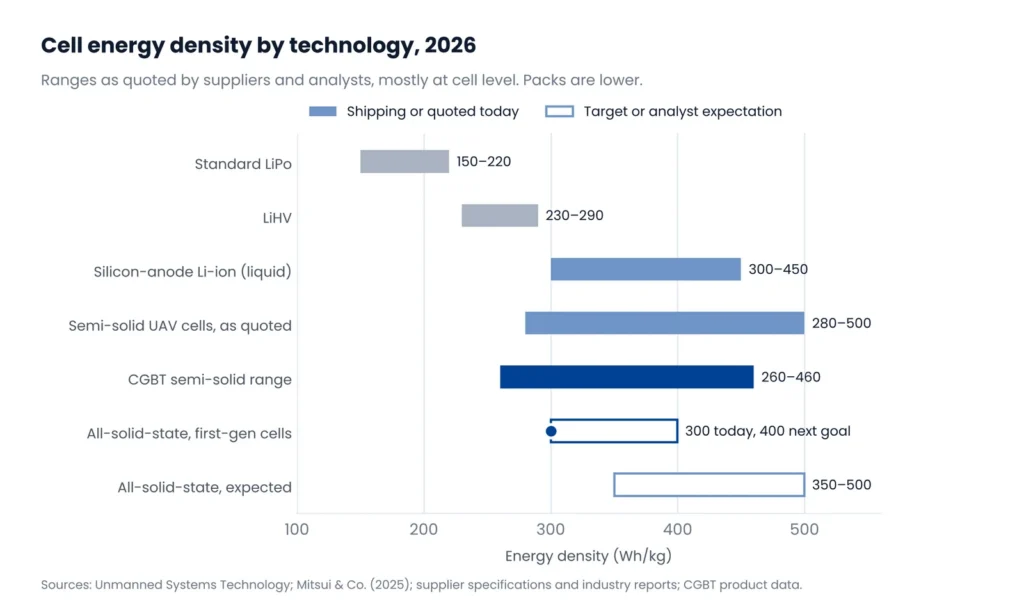
Two honest caveats. First, much of the gain comes from the electrodes, not the electrolyte: higher energy density needs high-voltage, high-capacity cathodes and silicon or lithium-metal anodes [9]. The gel or solid electrolyte helps those materials survive and lowers fire risk. That is why liquid silicon-anode lithium-ion cells also reach 300–450 Wh/kg [5], and why “semi-solid” alone tells you nothing about Wh/kg: CGBT’s own range spans 260 to 460. Second, these are cell figures. A finished pack is always lighter on energy per kilogram; our article Cell vs Pack Energy Density shows by how much.
4. Power: where LiPo still wins
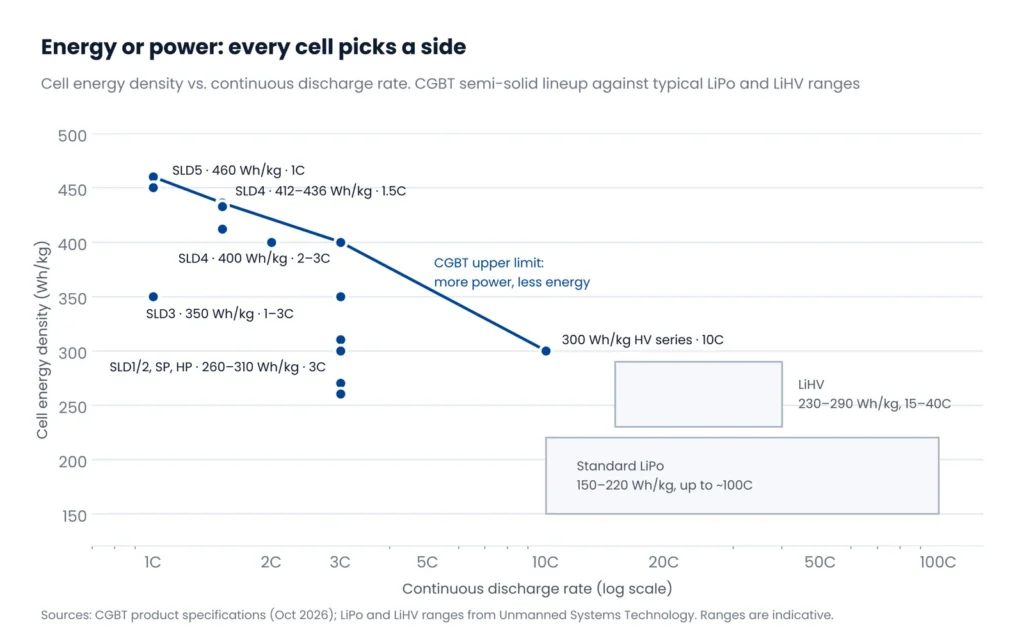
Every cell trades energy for power. Thicker electrodes and more active material store more energy but make it harder to push current through quickly. CGBT’s own lineup shows the trade clearly: 460 Wh/kg at 1C continuous, 412–436 Wh/kg at 1.5C, 400 Wh/kg at 2–3C, and 300 Wh/kg at 10C [10]. Standard LiPo is quoted up to about 100C [5].
What that means in practice:
- FPV and racing need tens of C in bursts. LiPo and LiHV remain the right choice; only long-range FPV, where endurance matters more than punch, benefits from 300 Wh/kg, 10C semi-solid packs.
- Agricultural spraying takes off near maximum weight every few minutes and charges fast between sorties. A mainstream 30 Ah spraying battery from a leading drone maker is rated 11.5C discharge and 1,500 cycles [11]. High-energy semi-solid cells are not built for that duty.
- Hover-dominated missions need much less. A 14.5 kg quadcopter in our cell-vs-pack example hovers at about 0.75C on a 12S 48Ah pack, which suits a high-energy 1C cell.
A quick check: divide your highest sustained power by the pack’s nominal voltage to get current, then divide by capacity in Ah. Keep that C-rate comfortably below the continuous rating.
5. Safety: better, not “safe”
Less flammable liquid means a lower chance of ignition. But Mitsui notes that the risk of ignition under abnormal heat “cannot be completely eliminated”, because semi-solid cells still contain some flammable organic solvent [1]. Under external heating, quasi-solid cells can still go into thermal runaway; it may start at a higher temperature and be slightly less energetic, while an internal short can release heat comparable to a liquid cell [2]. Researchers also note that the long-term safety of high-energy quasi-solid cells is not yet fully validated [9]. Our semi-solid-state engineering guide covers thermal safety in more depth.
All-solid-state cells remove the flammable liquid altogether, which is their strongest argument. For drones, though, there is still little published field data.
In daily operation nothing changes. Every chemistry still needs a BMS, balanced charging and sensible storage. Transport rules depend on the lithium content, not the electrolyte: packs need UN38.3 testing [13], and since 1 January 2026 lithium-ion batteries shipped by air must be at or below 30% state of charge [12]. Ask for cell abuse-test reports (nail penetration, overcharge, thermal) and the UN38.3 summary for the pack, whatever the label says.
6. Cold weather, cycle life and cost
Cold weather
Lithium cells lose capacity in the cold. Under IEC 61960-3, typical pass thresholds at −20 °C are only 50–60% of nominal capacity [14]. Many semi-solid packs are rated to discharge at −20 °C, and several CGBT SLD4 packs (60 Ah, 80–86 Ah and 150 Ah) are rated down to −40 °C [10]. One hybrid solid-liquid cell maker claims about 90% capacity retention in extreme cold, against roughly 40% loss for liquid cells [15]. Treat all such claims, ours included, as a starting point: a temperature rating is not a capacity figure, so ask for measured capacity at your lowest operating temperature.
Cycle life
LiPo typically lasts 300–500 cycles and LiHV 300–400 [5]. Semi-solid varies widely by design: CGBT’s 460 Wh/kg SLD5 and 412–436 Wh/kg SLD4 packs are rated 300 cycles, our 400 Wh/kg SLD4 80–150 Ah packs 500 cycles [10], and another supplier quotes more than 500 cycles to 90% capacity [7]. The highest-energy cells are rarely the longest-lived. Always ask how cycle life is defined: to what remaining capacity, and at what charge and discharge rates.
Cost
Semi-solid costs more per watt-hour, and all-solid-state more again. Public figures come from electric vehicles: one carmaker’s semi-solid pack was estimated at 1.7–2.2 CNY/Wh against about 0.73 CNY/Wh for mainstream NMC [1], and production-ready solid-state cells cost roughly twice as much per Wh as liquid cells [15]. For a drone fleet, the useful number is cost per flight hour: pack price ÷ (cycles × flight hours per cycle). A pack that costs more but flies much longer per cycle can still come out cheaper per hour, or it may not. Run the numbers for your own mission.
7. All-solid-state in 2026: what is real
- Volume. Solid-state battery shipments reached 8.0 GWh in 2025, and every commercial-scale cell among them was semi-solid, according to EVTank data reported by Battery-Tech Network [16].
- First UAV-focused cells. One of China’s largest battery makers opened an all-solid-state line in September 2025. Its first-generation 10 Ah cell is rated 300 Wh/kg, with 400 Wh/kg as the next goal, and is aimed at UAVs, humanoid robots and AI equipment [8].
- Demonstration flights. A US solid-state developer shipped lithium-metal cells to a Canadian cargo-drone maker for demonstration flights in 2025 [17], and in May 2026 announced pack-integration partners in the US, Europe and South Korea, without a commercial availability date [18]. Battery-Tech Network describes the same developer’s cells as quasi-solid rather than fully solid [16].
- Large-scale all-solid-state production is planned from 2027 by major Korean and Japanese manufacturers, in the second half of 2027 and in 2027–2028 [16]. Earlier target dates have slipped before.
Our view: if you run a qualification program, all-solid-state cells are worth testing now. If you need to equip a fleet this year, semi-solid is the practical upgrade from LiPo. Market analysts agree on the direction: LiPo is expected to hold the largest share of drone batteries in 2026, with semi-solid and solid-state the fastest-growing segments [19].
8. Which should you choose?
This is how CGBT’s engineers match technology to mission. It is a starting point; airframe, payload and climate decide the final choice.
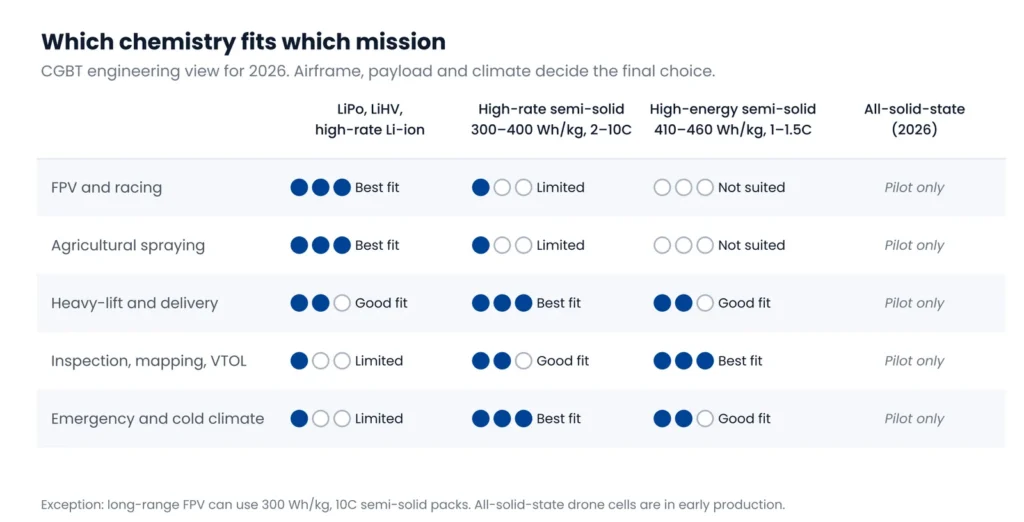
- Inspection, mapping and VTOL: long, steady flights at low C-rates. High-energy semi-solid (410–460 Wh/kg) gives the most minutes per kilogram.
- Heavy-lift and delivery: high take-off power plus endurance. High-rate semi-solid at 350–400 Wh/kg and 2–3C continuous is usually the best balance; check peak current for climbs and winch work.
- Emergency response and cold climates: packs rated for −40 °C discharge and lower fire risk matter more than the last few Wh/kg.
- Agricultural spraying, FPV and racing: stay with high-rate LiPo, LiHV or Li-ion smart packs.
Switching from LiPo? Check the voltage window
Semi-solid packs are often not drop-in replacements. CGBT’s SLD4 and SLD5 cells, for example, have a 3.5 V nominal voltage, charge to 4.3 V and are rated to discharge down to 2.5 V per cell [10], while standard LiPo peaks at 4.2 V per cell [5]. A LiPo charger profile will leave capacity unused, and LiPo low-voltage alarms will trigger too early. Use the supplier’s charge profile, update the flight controller’s voltage thresholds and never mix chemistries on one charger setting.
9. Five questions to ask before you buy
- Which electrolyte category is the cell (liquid, hybrid solid-liquid or all-solid-state), and what is its liquid content?
- Is the quoted Wh/kg a cell or a pack figure?
- What are the continuous and peak C-ratings, and how do they compare with your mission current?
- What capacity does the pack deliver at your lowest operating temperature, and how is cycle life defined?
- Which safety reports can you share: UN38.3 for the pack and abuse tests for the cell?
Our article Cell vs Pack Energy Density adds seven more questions focused on Wh/kg claims.
Bottom line
There is no single best drone battery in 2026. LiPo remains the power and price champion. Semi-solid is the technology that delivers higher energy density you can buy in volume today, with lower but not zero fire risk. All-solid-state is real but early: worth testing, not yet worth betting a fleet on. Pick by mission, verify every claim with test data, and expect the picture to change again by 2028.
Not sure which chemistry fits your drone? Send CGBT your airframe weight, payload, mission profile and operating temperature. Our engineers will recommend a chemistry and pack configuration, including when a high-rate pack is the better answer. Request a quote.
Frequently asked questions
Is a semi-solid battery the same as a solid-state battery?
No. A semi-solid (hybrid solid-liquid) cell still contains some liquid electrolyte; an all-solid-state cell contains essentially none. China’s GB/T 43568-2026 draws the line at 5% liquid by mass plus a vacuum weight-loss test.
Are semi-solid drone batteries safer than LiPo?
They carry less flammable liquid, which lowers the risk of ignition, but the risk is not eliminated. They still need a BMS, careful charging and dangerous-goods handling.
Can I replace my LiPo pack with a semi-solid pack directly?
Often physically, but check the voltage window, C-rating, connector and charger profile first. Many semi-solid cells charge to a different voltage and run at a lower nominal voltage than LiPo.
When will all-solid-state drone batteries be widely available?
First-generation UAV cells are in early production now, at about 300 Wh/kg. Higher-energy versions and large-scale production are planned from 2027, and timelines have slipped before.
References
- Mitsui & Co. Global Strategic Studies Institute, Semi-Solid-State Batteries, 2025. mitsui.com
- Wikipedia, Semi-solid-state battery. wikipedia.org
- Battery Design, GB/T 43568-2026. batterydesign.net
- SMM, Global Landscape Analysis of Solid-State Battery Regulations, Policies and Standards (Q2 2026). news.metal.com
- Unmanned Systems Technology, Lithium Polymer (LiPo) Batteries. unmannedsystemstechnology.com
- Battery manufacturer technical article on drone battery innovations, September 2025 (brand omitted).
- Supplier specification page for semi-solid UAV batteries, October 2026 (brand omitted).
- CnEVPost, report on the start of all-solid-state battery production, September 2025.
- Fan et al., High energy density quasi-solid-state lithium batteries using in situ polymerized gel electrolytes, Chemical Science (RSC), 2026. pubs.rsc.org
- CGBT product specifications, SLD1–SLD5 semi-solid-state drone batteries, October 2026. szcgbt.com
- Retailer listing for a 30 Ah agricultural spraying drone battery, 2026.
- The Compliance Center, lithium battery state-of-charge requirements, 2026. thecompliancecenter.com
- Tritek, How to ship lithium batteries by air. tritekbattery.com
- Battery Design, Cell capacity testing: standards, diagnostics and safety. batterydesign.net
- Notebookcheck, report on solid-state battery cost and a hybrid solid-liquid cell launch, March 2026.
- Battery-Tech Network, Why Sodium-Ion Won 2026 and All-Solid-State Is Still a 2027 Bet, October 2026. battery-tech.net
- Business Wire, press release on a first solid-state cell shipment for drone deployment, May 2025.
- Developer press release on drone battery integration partners, May 2026 (brand omitted).
- Meticulous Research, Drone Batteries Market 2026–2036, October 2026. meticulousresearch.com