
Materials, C-rate capability, and pack engineering for semi-solid-state drone batteries
Type: Industry education article, technical edition
Date: July 3, 2026
Focus: Semi-solid-state batteries for UAV and industrial drone platforms
Abstract
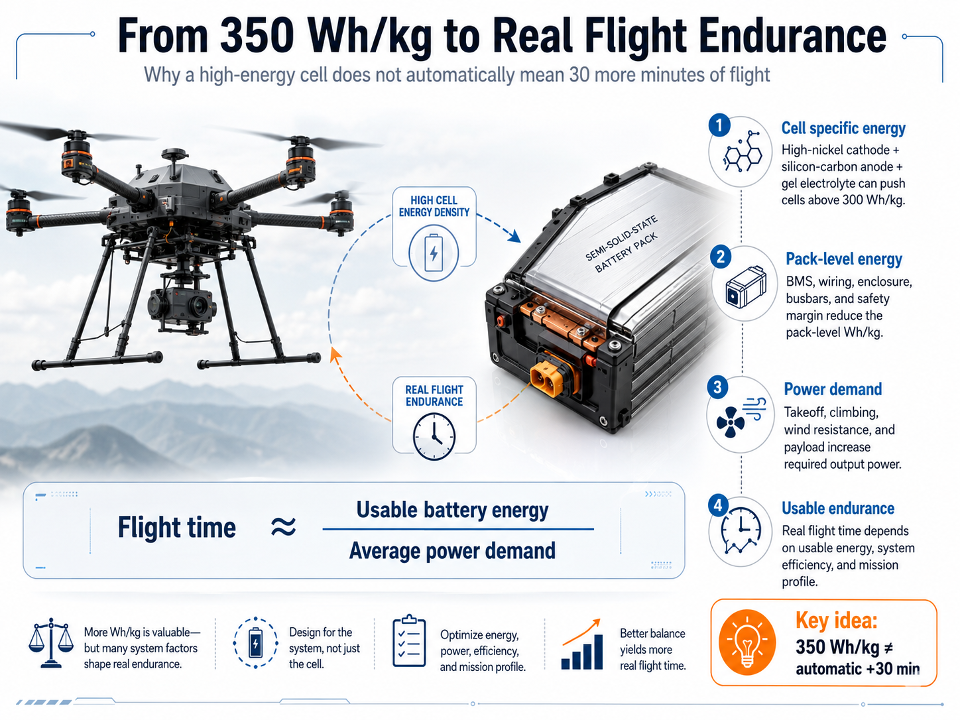
Semi-solid-state batteries are getting attention in the drone industry because they sit between conventional liquid-electrolyte lithium cells and fully solid-state designs. They can use high-nickel cathodes, silicon-carbon anodes, gel or quasi-solid electrolytes, and lightweight pouch construction to move cell specific energy above 300 Wh/kg. That number matters, but it is only the start.
For a drone, cell data has to survive the move into a pack. Busbars, wiring, enclosure, BMS hardware, thermal design, reserve limits, and current derating all decide how much of the advertised energy becomes usable flight time. A 350 Wh/kg cell does not automatically add 30 minutes of endurance.
This article covers material systems, interfaces, discharge rate, pack-level specific energy, thermal safety, BMS strategy, procurement validation, and application fit. The goal is practical: help drone teams decide when semi-solid-state batteries are useful and when a high-rate LiPo or a hybrid power architecture still makes more sense.
Keywords: semi-solid-state battery; drone; UAV; high-nickel cathode; silicon-carbon anode; gel polymer electrolyte; C-rate; pack-level specific energy; BMS
Article structure
- Why drone batteries face stricter constraints than EV batteries
- Where semi-solid-state batteries get their specific energy
- Why 350 Wh/kg is not the same as a high-rate drone battery
- Why pack-level specific energy decides real flight time
- Thermal safety: lower risk, still a thermal-runaway problem
- The BMS needs to manage available power, not only state of charge
- Procurement and validation: how to read supplier specifications
- Best early applications for semi-solid-state drone batteries
1. Why drone batteries face stricter constraints than EV batteries
The growth of the low-altitude economy has put drone batteries in a difficult engineering role. The battery is the energy source, but it is also part of the payload. In an electric vehicle, extra battery mass mainly raises rolling energy consumption. In a multirotor drone, every extra kilogram has to be lifted by the propellers for the whole flight. More battery can mean more energy, but it also raises hover power.
That is why drone power batteries cannot be judged by capacity alone. Teams need to look at cell specific energy, discharge rate, usable capacity at low temperature, thermal limits, and pack-level specific energy together.
Policy targets are pushing the same direction. China’s Implementation Plan for Innovative Application of General Aviation Equipment (2024-2030), released by the Ministry of Industry and Information Technology and other departments, calls for mass production of 400 Wh/kg-class aviation lithium batteries and application validation of 500 Wh/kg-class aviation lithium batteries. Those targets are meant for aviation scenarios such as drones, eVTOL aircraft, and electric propulsion for general aviation, not ordinary consumer electronics cells. [1]
Semi-solid-state batteries draw interest because they occupy a practical engineering window. They are more capable than many conventional liquid-electrolyte lithium batteries at reaching beyond 300 Wh/kg, while still fitting more easily into existing lithium-battery manufacturing than fully solid-state cells. A 2025 Mitsui & Co. Global Strategic Studies Institute report places semi-solid-state batteries between liquid-electrolyte and fully solid-state routes, including solid-liquid hybrid and gel-polymer designs. The same report notes that lower electrolyte fluidity can reduce leakage and fire risk, but it does not remove fire risk from the system. [2]
Table 1. Core evaluation dimensions for drone power batteries
| Metric | Why it matters | What to verify |
| Cell specific energy, Wh/kg | Shows how much energy is stored per unit of cell mass and sets the upper limit for endurance. | Confirm whether the figure describes a bare cell, a cell with tabs, or a complete pack. |
| Pack-level specific energy, Wh/kg | The aircraft carries a finished pack, not loose cells. | Include enclosure, wiring, BMS, busbars, mounting parts, insulation, and safety margin. |
| C-rate capability | Takeoff, climb, wind resistance, and loaded hover all require power, not only stored energy. | Separate continuous C-rate from 10 s pulse, 30 s pulse, and mission-profile capability. |
| Temperature rise, Delta T | I^2R heat at high current can trigger current limiting, faster aging, or safety risk. | Ask for shell temperature, cell-core temperature, cooling conditions, and maximum mission current. |
| SOH degradation | Capacity fade and resistance growth reduce return-to-home margin. | Use drone mission-cycle tests, not only 0.2C laboratory cycling. |
2. Where semi-solid-state batteries get their specific energy
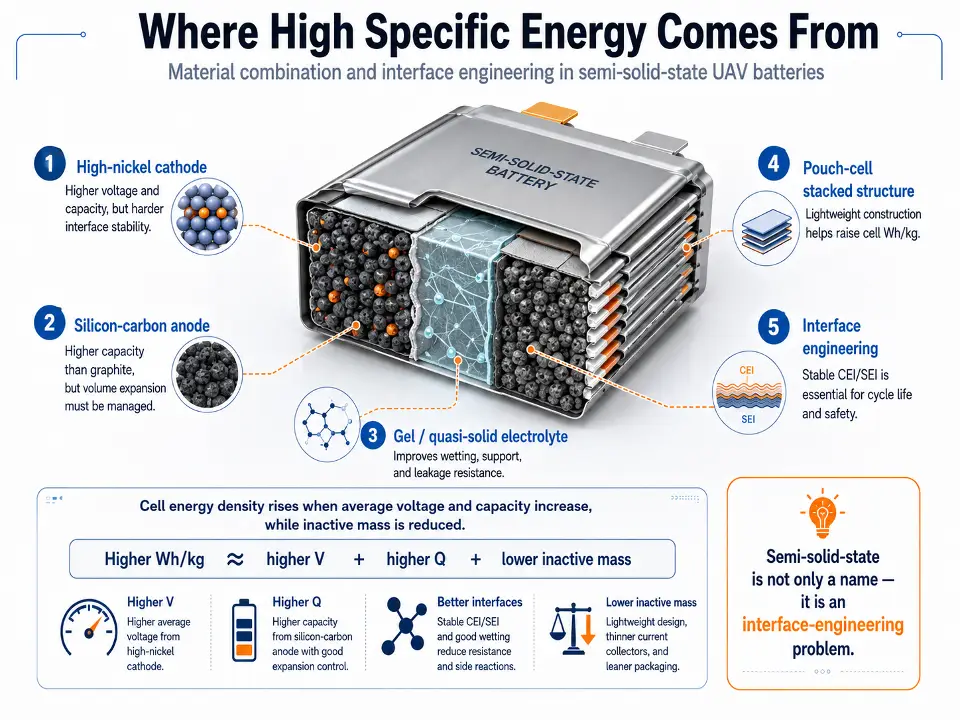
A common high-energy semi-solid-state drone cell combines these elements:
- a high-nickel cathode
- a silicon-carbon anode
- a gel or quasi-solid-state electrolyte
- a stacked pouch-cell structure
- a stronger push to reduce inactive material
At cell level, specific energy can be simplified as:
E_cell ~= integral V(SOC) * Q dSOC / (m_active + m_inactive)
Raising Wh/kg means increasing average voltage, increasing capacity, reducing inactive mass, or improving several of those variables at once. The useful part of the technology is not the label “semi-solid-state”. It is the way the cathode, anode, electrolyte, separator, and cell structure work together.
2.1 High-nickel cathodes: higher voltage and capacity, harder interfaces
The cathode side usually starts with high-voltage, high-capacity materials such as high-nickel NMC or NCA. These materials raise energy output, but they also make the interface less forgiving.
At high voltage, transition metals can catalyze electrolyte decomposition. The cathode-electrolyte interphase can become unstable, interfacial impedance can rise, and capacity can fade faster. A 2026 Royal Society of Chemistry review on quasi-solid-state lithium batteries notes that high-voltage cathodes and high-capacity anodes are needed for higher energy density, but they bring high-voltage oxidation, weaker interfacial stability, and unresolved safety validation problems. [3]
2.2 Silicon-carbon anodes: higher capacity, with expansion as the main problem
The second route is higher anode capacity. Graphite is limited by its theoretical capacity, while silicon-based anodes can store much more lithium. That is why silicon-carbon anodes are common in high-specific-energy drone battery designs.
The cost is mechanical stress. During deep lithiation, silicon can expand by more than 300%. That expansion can fracture particles, break conductive networks, tear and rebuild the solid-electrolyte interphase, consume active lithium, and accelerate capacity loss. A 2024 Nature Communications study on Si/NMC cells with gel polymer electrolytes also identifies silicon-anode volume expansion, high-voltage instability of high-nickel cathodes, and transition-metal crossover as major failure mechanisms. [4]
2.3 In-situ polymerized gel electrolytes: wetting and support in one step
The third route is the part most people mean when they say semi-solid-state: a gel polymer electrolyte or in-situ polymerized electrolyte that reduces the fluidity of a conventional liquid electrolyte.
In a typical in-situ polymerization process, a precursor liquid with monomers, lithium salts, plasticizers, and initiators is injected into the cell. It first wets the electrodes and separator, then polymerizes inside the cell to form a gel or quasi-solid network. Done well, this improves interfacial contact, lowers leakage risk, adds mechanical support, and can help buffer silicon-anode expansion.
The RSC review notes that in-situ polymerized gel electrolytes can form closer contact with electrode surfaces than externally prepared gels, reduce interfacial impedance, and serve as one possible route for commercial quasi-solid-state batteries. [3]
For drones, this makes semi-solid-state battery design an interfacial engineering problem. The hard part is keeping the cathode CEI, anode SEI, ion transport, mechanical stress, and thermal behavior under control at the same time.
Technical note: When a supplier emphasizes “semi-solid-state”, ask about electrolyte morphology, in-situ polymerization, liquid-component ratio, cathode and anode chemistry, separator or coating design, and interfacial impedance after cycling. The phrase alone does not tell you whether the cell is suitable for drones.
3. Why 350 Wh/kg is not the same as a high-rate drone battery
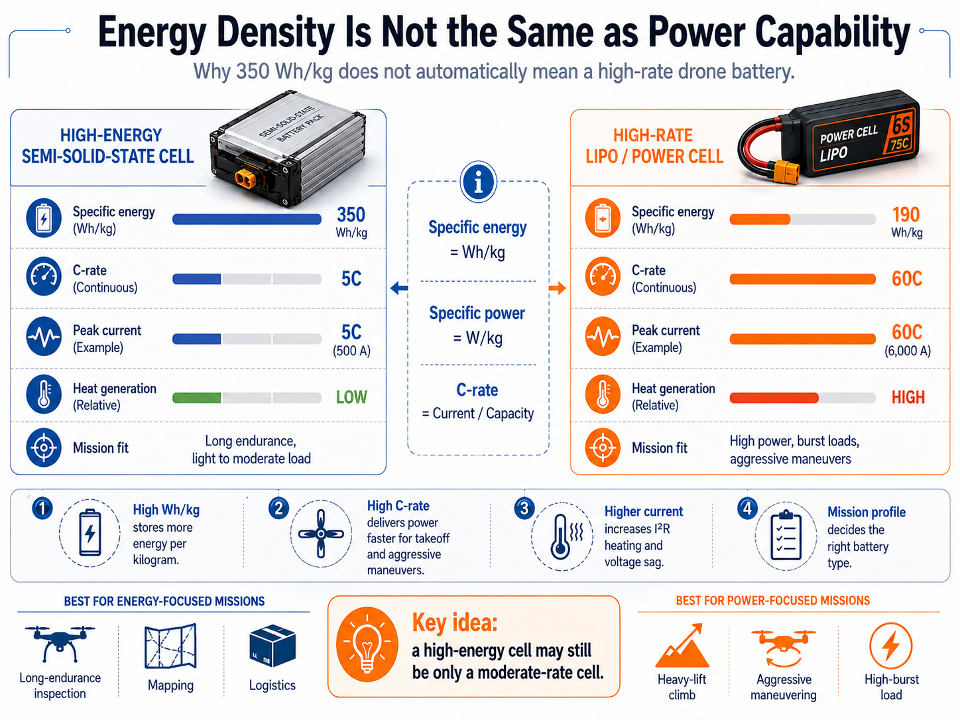
Wh/kg is the number most often lifted into sales material, and it is also the number most often misread. A drone battery has to store energy and deliver it quickly during takeoff, climb, wind resistance, and loaded hover. That means engineers have to separate specific energy from specific power.
Specific energy = Wh/kg
Specific power = W/kg
C-rate = I / Capacity (Ah)
A 1C discharge empties the battery in about one hour. A 10C discharge empties it in about six minutes. Monolithic Power Systems explains C-rate as discharge speed relative to maximum capacity, and also notes that higher discharge rates reduce usable capacity while high internal resistance produces more heat loss. [6]
So the first distinction is simple: a high-energy semi-solid-state cell is not automatically a high-rate cell.
For example, the public specification from 某品牌 for a 350 Wh/kg semi-solid-state cell lists a 3.7 V, 33 Ah cell, a maximum continuous discharge current of 33 A, and an energy density of 343 Wh/kg. Dividing 33 A by 33 Ah gives roughly 1C continuous discharge. That may work for long-endurance inspection, mapping, or logistics missions with modest C-rate demand. It should not be dropped into a highly maneuverable FPV drone, heavy-lift agricultural platform, aggressive climb profile, or frequent rapid-acceleration mission without recalculating parallel count, peak current, temperature rise, and voltage sag. [5]
This is also why conventional LiPo batteries have not disappeared. Industry data commonly places standard LiPo batteries around 150-220 Wh/kg, but their high-rate capability can be very strong. Silicon-based high-energy lithium-ion routes can reach higher Wh/kg, but they often fit medium- or low-rate endurance missions better than high-power missions. [7]
Evaluation should therefore move quickly from Wh/kg to maximum output power.
P_max = V_pack * I_max
If a 12S1P, 33 Ah battery pack uses the 33 Ah cell above, its nominal voltage is about 44.4 V and its continuous current is about 33 A. Its continuous output power is therefore:
44.4 V x 33 A ~= 1.47 kW
That may be enough for a long-endurance mapping drone. It may be tight for a heavy-lift agricultural drone or a large-payload multirotor. The fix is not simply a higher Wh/kg cell. Engineers may need more parallel cells, a higher system voltage, lower internal resistance, better heat dissipation, or a high-rate semi-solid-state or LiPo solution that gives up some energy density.
4. Why pack-level specific energy decides real flight time
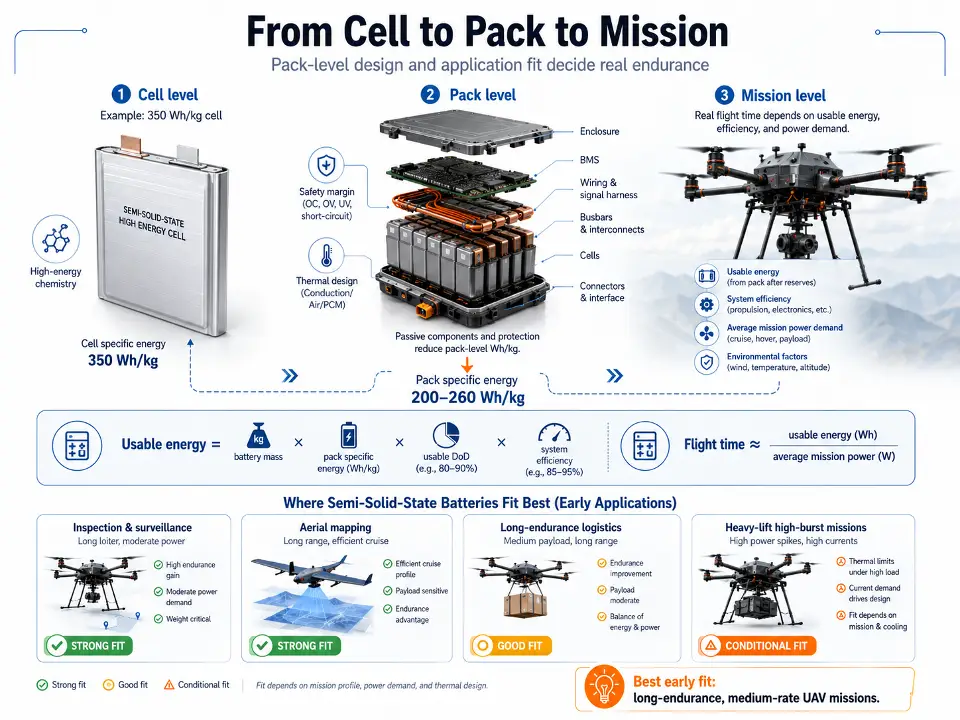
A 350 Wh/kg cell does not make a 350 Wh/kg battery pack. A finished pack also contains the enclosure, busbars, wiring, BMS, protection devices, mounting structure, insulation, and thermal design. BatteryDesign.net states the point directly: pack-level Wh/kg is always lower than or equal to the Wh/kg of the cells inside it. [8]
A 2025 study on cell-to-pack relationships makes the same practical point. Cell-level gains do not pass into pack-level gains one-for-one, because passive components change with the design and safety requirements. [9]
For drones, the simplified endurance model is:
t ~= E_usable / P_avg
E_usable = m_battery * e_pack * DoD * eta
Here, m_battery is pack mass, e_pack is pack-level specific energy, DoD is usable depth of discharge, and eta covers losses and reserves from ESCs, motors, wiring, and safety margin. Multirotor hover power also rises roughly with total weight W to the power of 1.5:
P_hover proportional to W^(3/2)
A heavier battery adds energy, but it also makes the aircraft consume more power. Drone battery sizing is a trade between carrying more energy and adding less weight.
4.1 Engineering example: same 4 kg battery, different endurance
Assume an industrial multirotor weighs 8 kg without the battery. It uses a 4 kg high-energy lithium battery pack with pack-level specific energy of 210 Wh/kg. Total takeoff mass is 12 kg, average power is 1.8 kW, and the combined usable factor DoD * eta is 0.8.
E_usable = 4 kg x 210 Wh/kg x 0.8 = 672 Wh
t = 672 Wh / 1,800 W = 0.373 h ~= 22.4 min
If the drone switches to a 4 kg semi-solid-state pack at 300 Wh/kg pack level, total mass stays the same and average power can be treated as roughly unchanged:
E_usable = 4 kg x 300 Wh/kg x 0.8 = 960 Wh
t = 960 Wh / 1,800 W = 0.533 h ~= 32.0 min
The theoretical endurance gain is about 43%.
If the mission needs the original endurance but more payload, the battery mass can fall from 4 kg to:
m = 4 kg x 210 / 300 = 2.8 kg
Total aircraft mass then drops from 12 kg to 10.8 kg. Using the W^1.5 approximation, average hover power becomes:
1.8 kW x (10.8 / 12)^1.5 ~= 1.54 kW
Even with usable energy held at 672 Wh, endurance rises to about 26.2 minutes and about 1.2 kg of payload capacity is freed.
This is where semi-solid-state batteries can matter for drones. The gain can be spent on endurance, payload, or reserve. It only appears in practice if C-rate capability, low-temperature behavior, and thermal design support the mission. Otherwise, voltage sag, over-temperature derating, and early low-voltage protection consume the paper gain.
5. Thermal safety: lower risk, still a thermal-runaway problem
The safety advantage of semi-solid-state batteries usually comes from three areas:
- lower electrolyte fluidity, which reduces leakage and volatility risk
- gel or polymer networks that add some mechanical support
- flame-retardant additives or phosphorus- and fluorine-containing systems that can improve combustion behavior
Those advantages are useful, but they do not remove thermal-runaway engineering. High-specific-energy systems store more energy in less mass. Internal short circuit, overcharge, nail penetration, crush, and high-temperature abuse can still create dangerous conditions.
Current is the most important variable in pack thermal design. Battery heat generation includes ohmic heat, polarization heat, and entropic heat. The most intuitive part is:
Q_ohmic = I^2 R
At the same 3 kW output, a 12S system carries roughly half the current of a 6S system, which can reduce ohmic heating in theory. Medium and large industrial drones often use higher series counts for this reason. The trade is more complexity in connectors, insulation, BMS sampling, balancing, and safe disconnect design.
One point is easy to miss: when cell-level safety improves, the bottleneck can move to pack-level heat propagation, sampling-wire reliability, connector contact resistance, and BMS current limiting.
In the Nature Communications study on Si/NMC gel polymer electrolyte cells, a 2.7 Ah pouch cell reached 325.9 Wh/kg, retained 88.7% capacity after 2,000 cycles, showed self-extinguishing behavior, and operated from -20 degrees C to 60 degrees C. This shows that gel polymer electrolytes can improve interfacial stability and safety behavior in high-specific-energy systems. [4]
The RSC review still warns that in-situ polymerized quasi-solid-state lithium-metal and high-specific-energy batteries face commercialization problems: high-voltage cathode oxidation, side reactions at high-capacity anodes, thermal safety, and polymerization uniformity. [3]
6. The BMS needs to manage available power, not only state of charge
A semi-solid-state drone battery BMS should manage available power, not just remaining energy. Ansys defines a BMS as a system that monitors the battery, protects it, estimates operating state, optimizes performance, and reports status to external devices. [10]
For semi-solid-state drone packs, that job includes at least four problem areas.
6.1 SOC estimation: terminal voltage alone is not enough at high C-rate
During high-rate discharge, terminal voltage is shaped by internal resistance and polarization. Voltage-only SOC estimation can therefore mislead the flight controller. MPS notes that SOC can be estimated through coulomb counting, open-circuit voltage correction, extended Kalman filtering, and related methods. Open-circuit correction requires rest time, which a drone often does not have during flight. [6]
6.2 SOH estimation: resistance growth can be more dangerous than capacity fade
Aging in a high-nickel cathode, silicon-carbon anode, and semi-solid-state interface does not show up only as capacity loss. Internal resistance can rise too. When it does, voltage sag during takeoff and return-to-home becomes worse, and temperature rise accelerates. A useful SOH model should track capacity, DC internal resistance, pulse resistance, temperature history, and cycle depth together.
6.3 Low-temperature current limiting: link temperature, SOC, SOH, and maximum current
At low temperature, ion transport and interfacial kinetics slow down in semi-solid-state electrolytes. If the BMS still allows room-temperature current, the pack can see rapid voltage sag, higher lithium-plating risk, or early undervoltage protection. Winter inspection, plateau mapping, mountain logistics, and similar work need current limits that depend on cell temperature, SOC, SOH, and mission demand, not only a fixed voltage threshold.
6.4 Mission-profile modeling: test flight conditions, not only constant-current cycles
A drone is not a constant-current device. A typical mission can include:
- 10-30 s of high C-rate during takeoff
- 30-90 s of medium to high C-rate during climb
- medium-rate discharge during route cruising
- medium-rate discharge during hovering and imaging
- another climb or wind-resistance event at low SOC during return
Real validation should use this type of mission-profile cycling, not only 0.2C or 0.5C laboratory cycling.
7. Procurement and validation: how to read supplier specifications
For drone manufacturers, the first question should not be “Is it semi-solid-state?” A better approach is to separate supplier claims into four layers: cell level, pack level, mission level, and safety level.
Table 2. Semi-solid-state drone battery selection checklist
| Question | Why ask it? | Acceptable validation material |
| Is the Wh/kg figure cell-level or pack-level? | The aircraft flies with a complete pack. | Cell datasheet, pack BOM, weighing data, and energy test report. |
| At what C-rate and temperature was capacity measured? | Low-rate capacity is not the same as usable flight capacity. | Capacity and voltage curves at 0.2C, 1C, and mission-relevant C-rates. |
| What are the continuous and pulse C-rates? | Peak C-rate does not represent sustained climb or wind-resistance capability. | 10 s, 30 s, 180 s, and full-duration continuous-discharge tests. |
| What is the temperature rise at maximum current? | Temperature rise sets current limits and safety boundaries. | Ambient temperature, cooling conditions, shell temperature rise, and cell-core temperature rise. |
| Is preheating required at low temperature? | Preheating consumes energy and reduces mission energy. | Low-temperature takeoff, capacity, internal resistance, and preheating energy data. |
| Under what conditions was cycle life tested? | Gentle laboratory cycling may not represent real flight missions. | Mission-profile cycling, capacity retention, internal-resistance growth, and failed-sample analysis. |
| Has pack-level safety testing been performed? | Cell-level safety is not the same as system safety. | Overcharge, short circuit, nail penetration, drop, vibration, thermal propagation, and BMS-failure testing. |
8. Best early applications for semi-solid-state drone batteries
Semi-solid-state batteries are not the best answer for every drone. They are most useful when longer endurance is worth more than extreme instantaneous power.
Mapping drones are a good early fit because route coverage depends directly on endurance. Powerline and oil-and-gas inspection drones are also strong candidates; fewer battery swaps improve single-sortie efficiency. Logistics drones can benefit when energy, payload, and reserve can be redistributed under the same takeoff-weight limit. Long-endurance security, emergency-response, and communications drones can also benefit because they often need stable hover and long on-station time.
Heavy-lift agricultural drones, high-speed FPV drones, highly maneuverable loitering platforms, and aircraft with frequent rapid acceleration need more caution. These use cases may still need high-rate LiPo packs or a hybrid architecture:
Hybrid option: high-energy semi-solid-state main battery + high-power buffer battery or supercapacitor
The goal is not to maximize Wh/kg by itself. The goal is to maximize usable mission energy under a specific flight profile.
Table 3. Application suitability of semi-solid-state batteries in drone scenarios
| Scenario | Suitability | Main benefit | Main risk |
| Mapping / aerial survey | High | More coverage per sortie and fewer battery swaps. | Validate capacity and voltage plateau at low temperature and high altitude. |
| Powerline / oil-and-gas inspection | High | Long endurance and reserve energy are valuable. | Model mountain winds and return-phase power margin. |
| Logistics drones | Medium to high | Payload, range, and reserve energy can be rebalanced. | Mission C-rate, regulatory safety margin, and pack-level tests are demanding. |
| Agricultural drones | Medium | Useful for some long-endurance work profiles. | Heavy-load takeoff and frequent fast charging stress C-rate, temperature rise, and cycle life. |
| FPV / high-speed maneuvering | Low to medium | High specific energy has limited value. | Instantaneous power demand is high; high-rate LiPo may still fit better. |
Conclusion: battery competition is system engineering competition
For drone use, a cell label such as 350 Wh/kg or 400 Wh/kg is only the starting point. The pack has to deliver four things at the same time in real missions:
Wh/kg + C-rate + Delta T + SOH
Pack-level specific energy, C-rate capability, temperature-rise behavior, and degradation curves all have to hold together. Semi-solid-state batteries are not only a preview of fully solid-state batteries, and they are not a drop-in replacement for every LiPo pack. They are better understood as a system-level compromise for industrial drones.
High-nickel cathodes and silicon-carbon anodes raise energy density. Gel or quasi-solid electrolytes can improve interfaces and safety behavior. Pack design, BMS control, and mission-profile management decide whether those cell-level gains become flyable, maintainable, and scalable power systems.
The useful comparison will not be whose cell has the highest Wh/kg on a datasheet. At the same nominal energy density, the better battery system is the one that still gives the flight controller a trustworthy available-power boundary after low-temperature operation, heavy payloads, strong wind, and hundreds of aging cycles. That is where semi-solid-state batteries will prove their value in industrial drone work.
References
- Ministry of Industry and Information Technology of China and other departments. Implementation Plan for Innovative Application of General Aviation Equipment (2024-2030), related public release.
https://gxj.nanjing.gov.cn/njsjjhxxhwyh/202404/t20240401_4199830.html - Mitsui & Co. Global Strategic Studies Institute. Semi-Solid-State Batteries report, 2025.
https://www.mitsui.com/mgssi/en/report/detail/__icsFiles/afieldfile/2025/03/27/2501btf_zhao_ishiguro_e.pdf - Royal Society of Chemistry. Review on quasi-solid-state lithium batteries, 2026.
https://pubs.rsc.org/en/content/articlehtml/2026/sc/d6sc01543c - Nature Communications. Gel polymer electrolyte Si/NMC pouch cell study, 2024.
https://www.nature.com/articles/s41467-024-49713-z - 某品牌. 350 Wh/kg semi-solid-state high-energy-density battery specifications.
Public specification page; brand URL omitted for anonymization. - Monolithic Power Systems. Battery parameters and BMS fundamentals.
https://www.monolithicpower.com/en/learning/mpscholar/battery-management-systems/introduction-to-battery-technology/battery-parameters - Unmanned Systems Technology. Lithium polymer batteries and UAV battery characteristics.
https://www.unmannedsystemstechnology.com/expo/lithium-polymer-lipo-batteries/ - BatteryDesign.net. Pack gravimetric energy density.
https://www.batterydesign.net/pack-gravimetric-energy-density/ - MDPI Vehicles. Cell-to-pack energy density relationship, 2025.
https://www.mdpi.com/2032-6653/16/9/484 - Ansys. What is a battery management system?
https://www.ansys.com/simulation-topics/what-is-a-battery-management-system